Canada Investment Summit tests investor appetite for fossil fuel infrastructure
As Canada opens the door to major institutional investors, its dealbook features a list of major oil and gas projects, will capital allocators see the appeal?
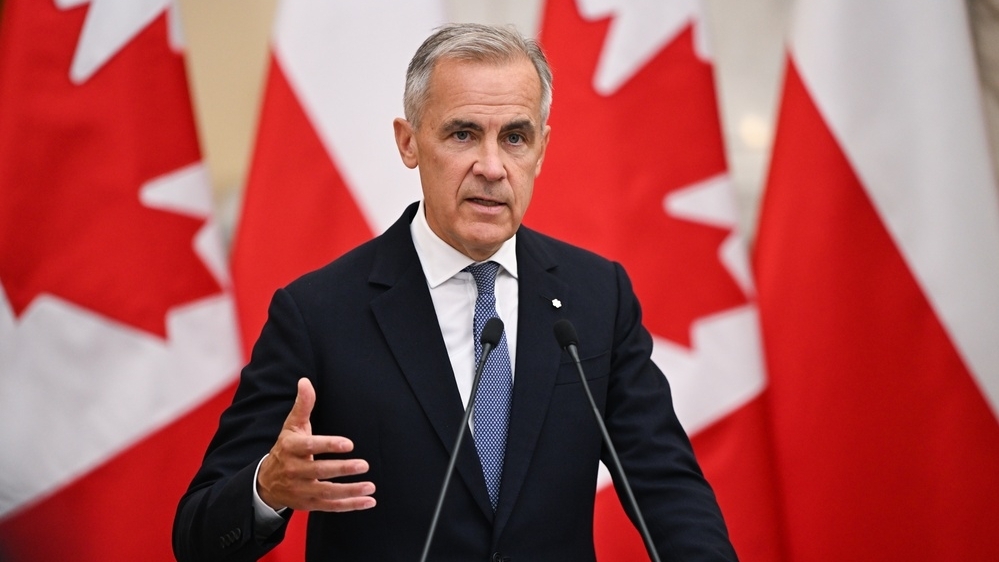
Against the backdrop of heightened trade tensions between the US and Canada, Carney’s Investment Summit aims to foster greater independence from its Southern neighbour by attracting some $1trn in investment over the next five years.
Kicking off the event, Canadian prime minister Carney said: “Canada is building such unparalleled market access because we are trusted, we are reliable and we have what the world wants, that is why the world is coming to our door.”
NZI Transition and Climate Investment Conference | 22 October | London | Register here
The pitchbook
The pitchbook, seen by Net Zero Investor, features some $460bn worth of deals, has a strong focus on the energy sector, which accounts for more than half of all projects being put forward. Among others, the Canadian government is seeking private capital to fund its West Coast Oil Pipeline and the Ksi Lisims and Kino Aski LNG pipelines.
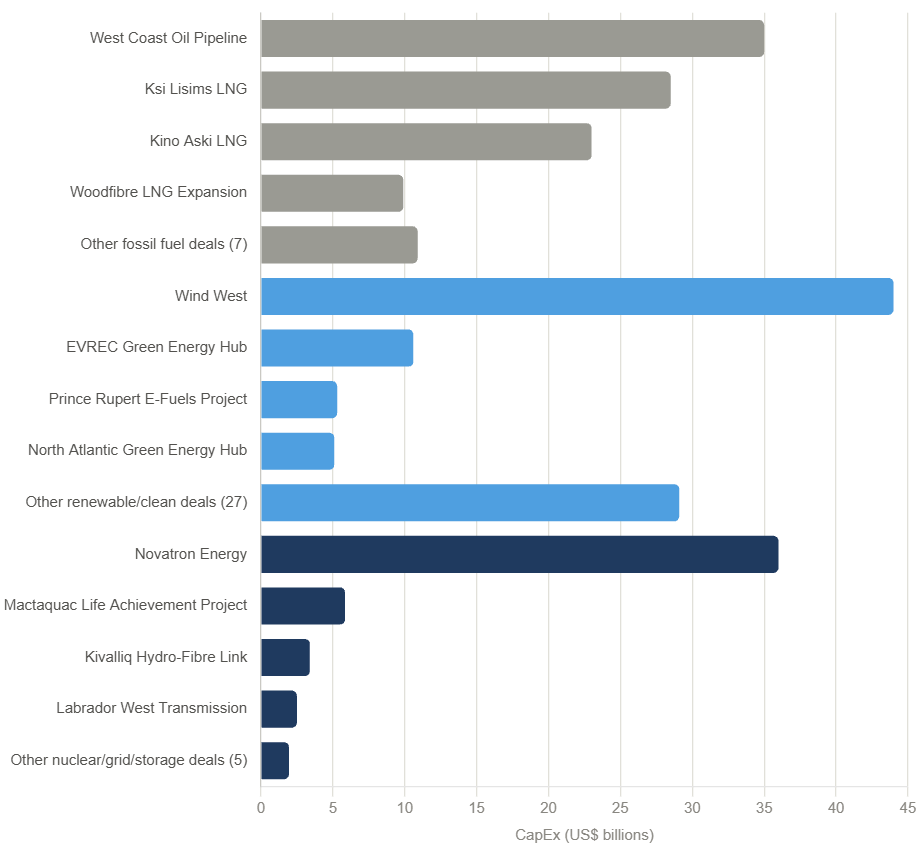
These ambitions represent a departure from the IEA recommendations, which outline that no additional oil and gas capacity is needed if the world is to limit global warming to be kept within the 1.5 degree limit.
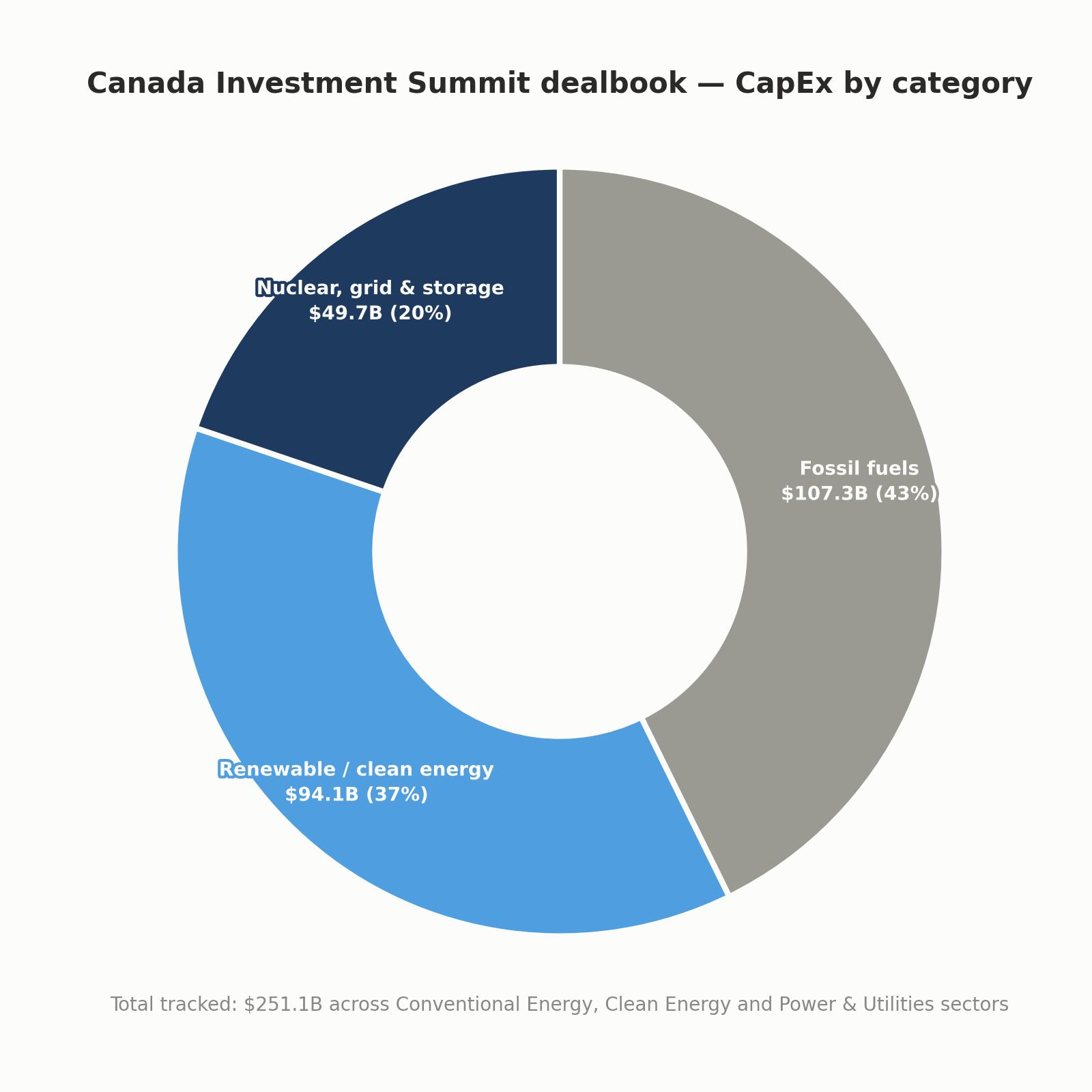
The dealbook further confirms Carney’s departure from climate leadership. Having spent years as UN Special Envoy on Climate Action and Finance and as head of ESG and Transition Investing, the Canadian PM now appears to pivot towards energy security, with the project pipeline offering a roughly even split between clean and brown energy projects, with some $107bn in fossil fuel projects competing for investor’s attention against $94bn in renewable energy investments. In addition, the dealbook also offers some $50bn in Nuclear and grid storage opportunity.
While the summit is already attracting some of the world’s largest investors, with BlackRock, PIF and Canadian pension giants such as PSP and CPPIB taking part, it has also drawn considerable protests, with civil society organisations and first nations raising concerns about a lack of consultation.
"Rather than being done transparently, more than 500 infrastructure deals with an associated price tag of $400bn , including $100bn in dirty oil and gas projects, are rather quietly pitched behind closed doors to mostly foreign financiers" argued Richard Brooks, climate finance leader at Stand Earth.
The pitfalls
While the Canadian government appears to be hedging its bets on the climate transition, a key litmus test will be if major investors will continue to back projects which bake in further fossil fuel expansion.
At first glance record-high oil and gas prices and growing demand for energy security are adding to the appeal of fossil fuel projects. Even prior to the summit, Canada announced plans for four new LNG projects in total and Canadian oil production reached a record high in 2025, which is expected to be topped again this year.
But a new report by think tank Pembina warns that expanding new greenfield fossil fuel projects would require billions of upfront investments and come at a considerable risk, according to Ian Sanderson, senior analyst and author of the report A Pipeline in Search of a Market, highlighting investment risks of building the planned new West Coast Oil Pipeline.
“Under current market conditions, the primary challenge facing Alberta producers is not a lack of export capacity, but uncertainty around future demand, prices and the economics of long-term oil infrastructure,” Sanderson said. “Those risks should not be shifted to taxpayers when the private sector is signalling that the project is too risky to finance on normal commercial terms” he added.
Among others, Sanderson warns that the new pipeline would come with extremely high transportation costs which would undermine its competitiveness. With build costs of up to $43.7bn, it would have to charge tolls which are 70 to 170% higher than the current Trans Mountain pipeline in order to recover its costs.
Brooks warned that investors seeking exposure to new oil and gas projects risked exposure to stranded assets: “This is an irresponsible suite of projects to put forward purely from a climate change perspective, made even more non-sensical after one of the worst wildfire seasons in Canada and the heatwaves and deaths we have seen from a distance in Europe. It's not the kind of projects that Canada should be leading with or championing” he said.
The pledges
As the summit draws to a close, it appears to have attracted significant additional investment, though for the most part, it remains still unclear whether this is to be allocated to renewables or fossil fuels.
Among others, CPP Investments and Brookfield Asset Management launched a $50bn Maple Fund to invest in critical infrastructure and strategic industries across Canada.
Meanwhile, PSP Investments has reaffirmed its commitment to increase its Canadian investments by 30 to 40%, an additional $25 billion in Canada, totalling $100bn.
The Ontario Teachers’ Pension Plan (OTPP) will invest an additional $10bn in Canadian opportunities across public and private markets by the end of 2027.
BCI has promised to expand its allocations to Canadian infrastructure from $116bn to $145bn by 2030, BCI’s CEO/CIO Gordon J. Fyfe announced. “We have the capital and conviction for the right opportunities, and are particularly interested in investments in defence, critical minerals, as well as existing infrastructure like airports, energy, and transportation, which are well suited to our clients' objectives.”
Significant backing has also come from Canadian Banks which collectively pledged some $325bn in new commitments into Canadian infrastructure, though again leaving the remit of their allocation deliberately open.
TD Bank said it will provide $150bn in financing over five years across five key sectors, including energy, critical minerals and resources, defence and aerospace, digital and AI, and infrastructure.
In addition, Scotiabank promised to provide over $100bn in financing over five years to support Canadian companies but without specifying specific sectors.
BMO said it will invest and mobilise $70bn in critical Canadian sectors over 10 years, including in energy and transportation infrastructure, mining and critical minerals, AI computing, and defence and security.
This comes against the backdrop of major Canadian banks having exited the Net Zero Banking Alliance last year.
As Canada’s Investment Summit draws to a close, major asset owners celebrated the event as a success. John Graham, president and CEO of CPP Investments said his team was “energised” by the gathering. “The real measure of this Summit will be what happens next, and I am confident the relationships and momentum built here can translate into meaningful investment and lasting economic value.”
Deborah Orida, president and CEO of PSP Investments said that a “solid foundation” had been put in place.
“In this new global investing regime, Canada is well positioned to compete for capital, and we are confident in the momentum already taking shape.”
With significant capital allocation pledges being made, key questions around the nation’s energy transition are still to be settled.