
European pension funds diverge on climate voting
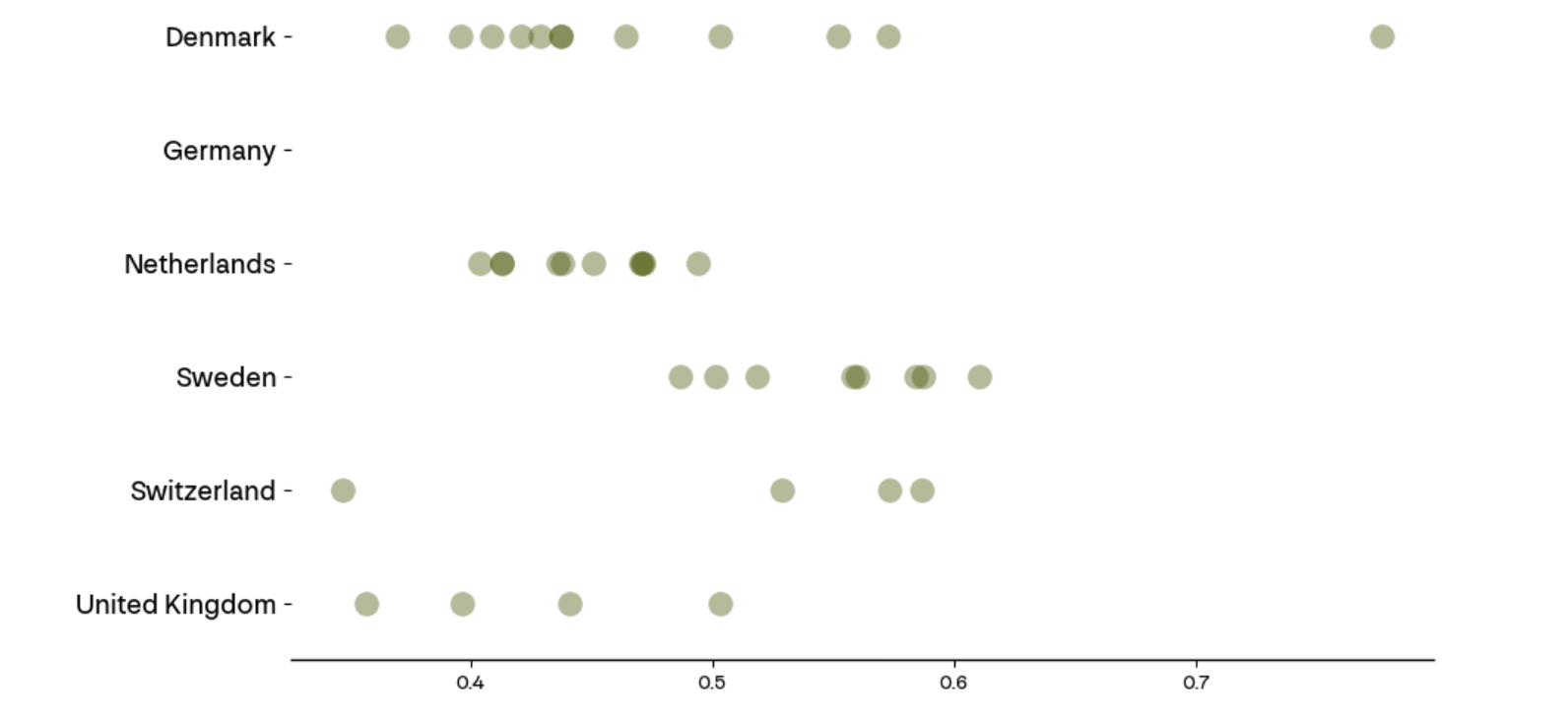
Swedish funds consistently achieve high climate alignment, whereas UK and Dutch funds tend to lag, with Danish and Swiss funds falling in between
There is a clear variation in voting behaviour on climate-related proposals among European pension funds, new research claims.
Swedish funds show the highest level of support; Switzerland follows in a mid-range position, though individual Swiss funds vary notably, with some nearing Sweden’s higher scores and others dipping closer to the broader midpoint. Denmark exhibits one of the widest spreads, spanning from some of the lowest levels of alignment to the single highest score in the sample, according to new research from sustainability data science company Rezonanz, revealing a clear divergence in voting behaviour on climate-related proposals among European pension funds.
By contrast, the Netherlands and the UK occupy the lower end of the distribution, suggesting comparatively weaker backing for climate-focused proposals overall. Meanwhile, the researchers couldn’t comment on German pension funds, due to critical data gaps and a lack of transparency.
The report analysed the voting practices of 42 pension funds, deriving climate scores from an analysis of 428 key proposals. It also looked at the quality of sustainability-linked disclosures for 122 pension funds.
While Dutch funds fared poorly on climate, they achieved consistently high on overall sustainability alignment and disclosures.
The researchers added that that purely voluntary stewardship codes, however strong, often fail to broaden stewardship beyond already committed institutions, citing the UK as an example.
Although the UK benefits from a strong stewardship code, it scored poorly on climate-related disclosures and voting practices, despite a TCFD reporting requirements for most larger UK pension funds.
Factors that influence a pension fund’s climate engagements
Size, pension fund type, sector of represented workers, and institutional culture may affect how pension funds vote and their level of transparency, the researchers note.
For example, size is crucial role in determining the resources and expertise available for responsible investment practices, including voting.
“In the UK, we have a problem with lots and lots of very small pension funds and there’s little resource for them to do anything...Better resourced funds have more time to do anything and one of the things could be voting,” said David Russell, chair of UK’s Transition Pathway Initiative, and former responsible investment head at Universities Superannuation Scheme.
By contrast, larger funds, such as those in the Netherlands’ consolidated market, possess stronger negotiating power and larger budgets, enabling them to afford mandate agreements that retaining voting rights and in some cases have the resources to define and execute their own voting policies, according to the researchers.
Whether a fund is private or public may also play a role. Lindsey Stewart, director of Stewardship Research and Policy at Morningstar Sustainalytics said the nature of the beneficiary base tends to be “a strong impetus for disclosing,” suggesting that large public funds, accountable to taxpayers and public employees, often feel more pressure to be transparent and proactive about their voting
In addition, pension funds often reflect the values and priorities of the industries or professions they serve, which can influence how actively they pursue both individual responsible investment topics and their approach overall.
A final explanation for variations in voting and disclosures practices come from the idea that “the idea that past decisions, norms, and institutional structures shape a pension fund system’s long-term trajectory,” the researchers note.
For example, the Dutch pension landscape, often noted for its early adoption of responsible investment principles, “benefited from the actions of influential leaders in the early 2000s” who embedded sustainability into national committees and spurred broader recognition of the importance of voting for pension funds.
Similarly, Scandinavian countries have cultivated a culture of openness and accountability, partly due to historical norms favouring collective decision-making and social welfare.