What are investors expecting from this year’s ‘finance’ COP in Baku?
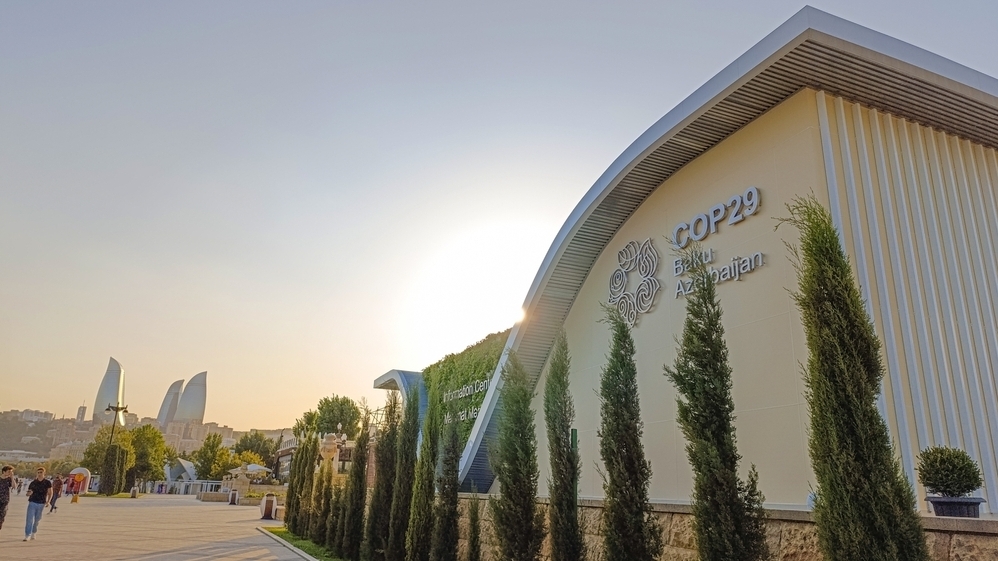
The 29th Conference of Parties (COP), the world’s largest annual gathering on climate, has kicked off in Baku, Azerbaijan. What are investors hoping to see?
This year’s COP29 Summit, held just a week after President Trump’s re-election, has been branded one of the most important climate summits since the Paris Agreement in 2015, as leaders are set to agree on a new climate financing target: the New Collective Quantified Goal (NCQG).
At COP21 in Paris, leaders committed to contributing at least $100bn per year to tackling climate change over the following decade. This ambition, now approaching its self-imposed deadline, has only narrowly been met since 2022, according to the OECD, with some estimates even questioning whether the goal has been achieved at all. Policymakers now need to agree on a new target, with most estimates suggesting at least $1trn in annual funding will be required to transition the global economy to net zero.
Sultan Abu Jaber, the outgoing COP28 president, summarised the challenge in his opening speech: “The critical success factor for all climate progress is finance. We continue to call on all sources, public and private, to make finance more available, more accessible, and more affordable,” he emphasised.
His successor, COP29 president Mukhtar Babayev, who also serves as the Azerbaijani minister of Ecology and Natural Resources, highlighted the current human impact of global warming. “Whether you see them or not, people are suffering in the shadows; they are dying in the dark and need more than compassion,” he stressed in his opening remarks.
Shortfalls and challenges
For now, aiding victims of climate change is not even accounted for in the $1trn per annum estimate. Countries in the Global South are now pressing to include loss and damage payments in the NCQG figure. Yet, climate finance efforts remain primarily focused on mitigation (cutting emissions) with some funding allocated to adaptation. Another significant challenge remains the lack of transparency, as individual countries assess their own contributions to climate finance.
Given the potential policy shifts of a second Trump administration, investors are watching with apprehension the possible impact of a reduced US commitment. The US has been a major contributor to the NCQG, with President Biden having pledged over $11bn per annum. Simultaneously, the US remains the largest historical contributor to climate change.
Between 2015 and 2022, government funding accounted for 80-90% of NCQG contributions, with private investment comprising only 10-20%, according to OECD data. As global borrowing costs rise, politicians are eager to attract more private investment. However, experts warn that non-concessional loans from institutions risk burdening already indebted countries in the Global South. Earlier this year, the IMF disclosed that over half of all low-income countries face a high risk of debt distress, with one-fifth of emerging market bonds trading at distressed levels. For institutional investors to fund climate adaptation in the Global South, they would need to balance these risks against lower-risk assets such as debt from high-income countries—a potentially unbridgeable gap without some form of risk-sharing with the public sector, many investors argue.
A crucial signal?
Ahead of the summit, Stephanie Pfeiffer, CEO of the Institutional Investor Group on Climate Change, stressed that the new funding target could play a vital role in attracting new investment: “The NCQG can unite all parts of the financial system by sending strong political signals, including a clear recognition of the private sector’s role,” she stated in a letter to Australian and Egyptian ministers serving as information consultants for the new target.
Her views were echoed by Olga Hancock, head of responsible investment for the Church Commissioners for England and lead of the policy workstream for the Net Zero Asset Owner Alliance: “We’d like the NCQG to send clear signals to the private sector that align incentives for investment in developing countries with the scaling and mobilisation of finance for adaptation and mitigation,” she said.
NZI DC Forum | Thursday 30 January | Stationer's Hall London | register here
"The New Collective Quantified Goal (NCQG) on climate finance will be vital in mobilising finance to accelerate climate action in developing countries, replacing the previous target, set in 2009, of US$100 billion per year by 2020, which developed countries were late to meet" adds Teju Akande, climate change manager at LGPS Pool Border to Coast.
In practice, this could mean more targeted grants and loans in sectors, technologies, and regions that struggle to attract private investments due to their risk-return profile, Pfeiffer explained in her letter.
Maria Nazarova-Doyle, global head of sustainable investment at IFM Investors, also sees scaling up climate finance as a key ambition this year but added that the $100bn goal has remained unmet and insufficient. “The biggest positive outcome of this COP could be agreeing a new ambitious target, with details such as which countries should provide finance, timelines, measurements, and the role of private finance.”
Attracting private finance will be crucial, yet challenging. In the days ahead,investors and policymakers will have to tread a fine line between attracting investment without placing an undue burden on overindebted countries in the Global South.