NZI Annual Conference 2025: adapting to a changing world
At Net Zero Investor’s Annual Conference, asset owners and investment leaders warned that the climate finance conversation must evolve from mitigation to adaptation as physical risks mount and political headwinds grow.
With the physical effects of climate change becoming increasingly tangible, the climate investment discussion is shifting towards how investors can adapt to a warming planet, asset owners have warned.
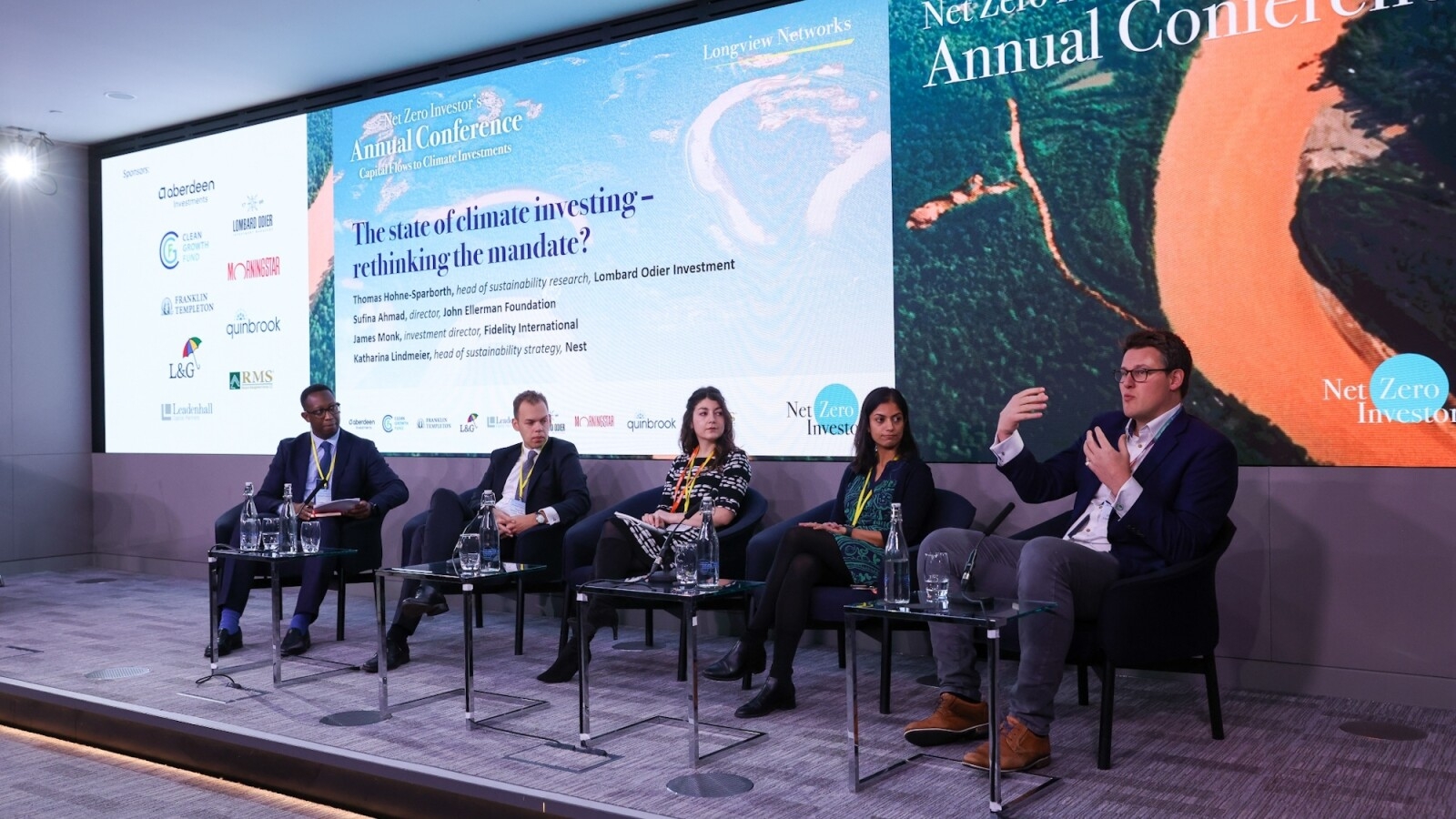
“We are drowning in data but we’re not acting fast enough. Climate and nature crises are now coming home to roost, and we need to come up with a different narrative,” said Sufina Ahmad, director at the John Ellerman Foundation, speaking during the opening panel at Net Zero Investor’s Annual Conference.
The event, held a month after scientists warned that seven out of nine planetary boundaries had been crossed, was dominated by a growing sense of urgency about tackling the climate crisis. Researchers warn that critical planetary boundaries ranging from biosphere integrity to ocean acidification, land-system change and freshwater use have now been breached, with the physical effects of climate change increasingly evident.
However, investors now face the reality that mounting physical pressures are being met with growing political pushback against climate investing, acknowledged Lindsey Stewart, director of institutional insights at Morningstar and chair of the event. “We have moved from policy tailwinds to open hostility,” he said, adding that “what was once a clear investment outlook has been replaced by uncertain strategy.”
For DC investors, this makes it even more important to engage with members on how better environmental and social outcomes will ultimately benefit them, argued Katharina Lindmeier, head of sustainability strategy at Nest. She added that asset owners had a key role to play in “shifting the dial” on supporting climate solutions and adaptation.
ESG investing may have become a buzzword, but “fundamentally, it is about sound risk management,” added James Monk, investment director at Fidelity International.
Speaking on behalf of Lombard Odier Investment Management, Thomas Hohne-Sparborth, head of sustainability research, said the political backlash had created mispricing opportunities for equity investors, stressing the importance of “good old-fashioned bottom-up work”. He acknowledged that much institutional capital was currently shifting towards AI and data centres, noting the excitement around the efficiency gains AI could bring.
“Fundamentally, sustainability is also just another word for more efficient processes. Data centres are considered a productivity boost, but for some reason we don’t connect the dots when it comes to energy efficiency,” he said.
Financing change in emerging markets
From floods to droughts, many of the physical effects of climate change are first felt in emerging markets, which at the same time struggle to attract the capital needed for both transition and adaptation.
Jake Harper, senior investment manager, private credit at Legal & General, argued that use-of-proceeds, debt conversion and outcome bonds could help bridge the $4trn financing gap required to achieve the UN Sustainable Development Goals by 2030.
For institutional asset owners such as DB and DC pension funds, a key attraction of these strategies is the backing from multilateral lenders such as the World Bank, in the form of wrapped or partially wrapped debt. While repayments for wrapped debt are typically guaranteed by a development finance institution or third party, partially wrapped debt offers limited uncovered exposure and a blended return, Harper explained. Examples include debt conversion bonds financing nature restoration in Ecuador, backed by liquidity guarantees from the Inter-American Development Bank, resulting in AA-rated debt.
The rise of insurance-linked securities
Another response to extreme weather events is the rise of insurance-linked securities (ILS), such as catastrophe bonds, which transfer the financial risks of natural disasters from insurers to investors. Alistair Jones, senior managing director and head of ESG at Leadenhall Capital Partners, noted that the ILS market has grown dramatically in recent years, from less than $5bn in the early 2000s to more than $120bn today.
While the number of climate-related weather events has risen, the sheer scale of the market has allowed it to absorb short-term yield spikes. “We have not had a negative year in ten years, and now we are seeing DB and DC players entering the market,” Jones said. “The risks from climate change are only increasing, and we need more solutions like ILS to help protect society and rebuild after crisis events.”
The data dilemma
The growing importance of adaptation finance was picked up in a later panel by Craig Cameron, senior vice president, portfolio manager and analyst at Templeton Global Investments. He was joined by Helena Threlfall, portfolio manager at LPPI, and Rahil Ram, head of investment strategy at NatWest Cushon.
“Mitigation has always been the focus, but adaptation has grown as a theme. As mitigation efforts have fallen short, there’s an obligation to turn to adaptation, not just as an opportunity but as a portfolio hedge,” argued Cameron. Ram added that only 40% of climate-related losses last year were insured.
Despite the abundance of data, a narrow focus on reducing emissions at portfolio level can sometimes obstruct adaptation investment, Cameron warned. “If you’re building flood defences or air conditioning, your product might have a high carbon footprint but it’s reducing physical harm. That’s hard to quantify and explain to investors.”
Ram explained that the NatWest Cushon Master Trust collaborates with Trex, a spinoff from the University of Exeter to measure physical risks: “We’re now directly implementing some of those adaptation risks into our construction,” he said.
Threlfall, who manages the £500 million Environment Opportunities Fund, noted that investors often struggle to measure the cost of something not happening. She also pointed to successful examples of adaptation delivering positive financial outcomes: “There’s interesting work in agriculture, finding more drought-tolerant crops or food systems that adapt to floods and water scarcity” she predicted.