
Institutional investors have identified infrastructure and renewable energy as key investment opportunities to fund the energy transition, amid record inflows into the asset class.
Institutional investors are turning their net zero efforts towards infrastructure, with 44% of investors identifying it as the asset class best suited to deliver their sustainability objectives, according to the latest Schroders’ annual Institutional Investment Survey.
The poll, conducted among 770 investors globally also revealed that 55% of respondents believe the attractiveness of infrastructure assets to deliver on net zero targets is set to increase over the next two years.
Second in line were equities, with almost a third of investors believing they offered opportunities for exposure to the energy transition.
Commodities, which historically have played only a minor part in most institutional portfolios were identified by nearly a quarter of all respondents as a key asset class for investors in the net zero transition.
This could be an indication that many investors are acutely aware that the transition to net zero will require a stark ramping up in the production of key strategic minerals. Analysts warn that rare minerals such as dysprosium, a vital component in EV production are currently dramatically underpriced, as previously reported on Net Zero Investor.
Investors’ interest in commodities is mirrored by demand for private equity, with another 24% of survey respondents stating their interest in its net zero credentials.
Last year has seen a sharp increase in demand for private market assets with infrastructure funds in North America and Europe emerging as the fastest growing asset class, according to alternatives data provider Preqin.
Fundraising for North American Infrastructure funds hit 68% in 2022, a trend that was largely driven by policy stimulus due to the Infrastructure Investment and Jobs Act (2021) and the Inflation Reduction Act (2022) in the US, the data provider said, with about $1.6trn in subsidies being unleashed into the infrastructure market within the next decade.
Meanwhile, the growth of the European infrastructure market was mainly expressed in a rising number of funds on offer, the product range grew by 35% over the last year.
Net Zero Targets
Despite US investors’ rising demand for infrastructure, the US market also has the lowest share of institutional investors endorsing net zero targets, with only 17% of respondents stating that they had set a net zero by 2050 target and had taken steps to adjust their portfolio accordingly.
This figure is much higher in the EMEA region, where 39% of respondents said they had put their net zero ambitions into action, against a global average of 29%.
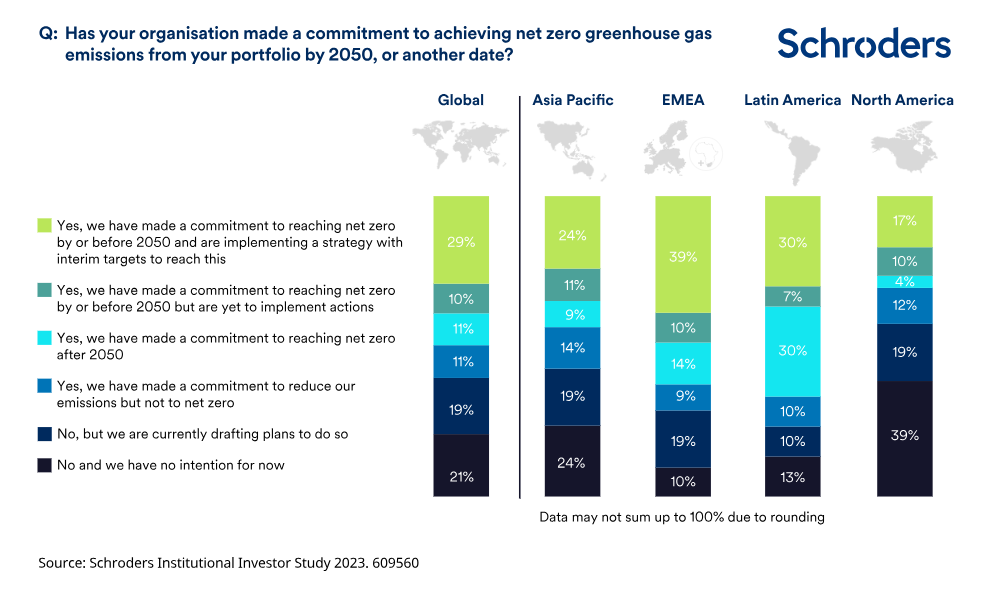
These figures could be relatively higher in the UK market. At LGIM’s annual client conference which took place earlier this week, 61 of attendees said they had a net zero target and 73% of those present said they had taken steps to implement their net zero targets.
Rising risks
But appetite for private markets could be dampened by an increasingly challenging investment environment with rising interest rates and inflation throwing spanners in the wheels of some private market firms which may depend on high levels of leverage.
This trend was already indicated in the latest Preqin poll. While in 2020, only 12% of investors were concerned about the impact of rising rates on their portfolios, that number grew to 56% by the end of 2022. With several rate hikes having taken place since then, it is likely to be even higher now.
But Nils Rode, CIO at Schroders Capital is confident that despite these risks, private markets still have a role to play:
“This year’s study shows that investors have grown less certain. Confidence levels have taken a knock from unstable, unpredictable geopolitics, and the delicate task facing central banks of cooling inflation without unwanted side-effects” he acknowledges.
“We think investors are right to exercise caution, but should also view this disruptive environment not as merely a temporary phase but the emergence of a new era altogether. What is clear from the study results, is that many investors continue to be drawn to private assets as a means to engage with the evolving macroeconomic landscape, as well as to add resilience to portfolios."