COP30 stocktake: what did Belém deliver?
With COP30 wrapping up, a fossil fuel phase-out agreement turned out to be elusive but COP30 delivered several investor-relevant outcomes. From TFFF and forest financing to grid investment and adaptation finance, here’s what the mutirão means for investors
A decade after Paris, signatories of the UN Framework Convention on Climate Change converged in picturesque Belém this year. Under the aegis of a Brazilian presidency that hosted the gathering in the heart of the Amazon, COP30 set out to chart a mutirão – a delivery plan for a decade long list of promises. The ‘implementation COP’, as it came to be known.
Two weeks of debates, announcements and negotiations led to a final package of decisions adopted on its final day. Looking back, here’s what COP30 delivered and what investors can take away from the Belém consensus.
The F-word
“Because we have already agreed that we will transition away from fossil fuels” said UN climate change executive secretary Simon Stiell at the opening plenary, “now’s the time to focus on how we do it fairly and orderly”.
At the end, an elusive global consensus on phasing out fossil fuel remained elusive. The final text does not make a reference to fossil fuels, and the debate over the language of phase outs remained divisive. 80 countries supported explicit language, the same number opposed it.
Ani Dasgupta, president and chief executive officer at the World Resources Institute notes the lack of a fossil fuel consensus, was a disappointing end to an otherwise optimistic few days in the Amazon.
“Many will leave Belém disappointed that negotiators couldn't agree to develop a roadmap to transition away from fossil fuels”, she says, “more than 80 countries stood their ground for a fair and equitable shift off fossil fuels, but intense lobbying from a few petrostates weakened the deal”.
Amidst the disappointment, rare glimmers of hope came through. The Brazilian Presidency announced it would create a fossil fuel roadmap outside of formal negotiations.
“Now it’s up to President Lula and the Brazilian COP presidency to turn that into a strong and inclusive global plan to transition away from fossil fuels”, Dasgupta says.
Halfway through COP30, South Korea’s delegation announced it would join the Powering Past Coal Alliance. The country is home to the world’s seventh largest coal fleet.
By 2040, the Koreans intend to shut down 40 of the country’s 61 coal power plants. It is only the second Asian country to sign up to PPCA, following the footsteps of Singapore.
“The shift from coal to clean power is not only essential for the climate. It will also help both the Republic of Korea, and all other countries increase our energy security, boost the competitiveness of our businesses, and create thousands of jobs in the industries of the future”, said Kim Sung-hwan, South Korea’s environment minister.
Financial instruments
The pessimism of fossil fuel phase-outs, however, did not extend into the optimism that surrounded climate solutions investing. COP30 included historic announcements and endorsements of new financing mechanisms.
The most noteworthy of which was the Tropical Forests Forever Facility (TFFF). Aimed at conserving tropical forests and giving developing countries a financial incentive to do so, the scale of TFFF is unique. TFFF is hoping to create a $125bn blended, leveraged investment fund, of which $100bn is expected to be institutional capital.
At its launch, in the days leading up to the COP30, commitments from sovereign backers stood at over $5bn. At the end of two weeks, TFFF has raised $6.7bn. Even though it is a long way from its target, its momentum and intent to become one of the world’s largest EM debt investors is one of COP30’s most significant legacies.
“TFFF has real potential to be a breakthrough for the world’s forests, and now more countries must step up with the finance required to turn promise into progress”, commented WRI’s Dasgupta.
Another significant development at COP30 was the focus on grid investments. Set against a backdrop of connection queues becoming a bottleneck for renewable energy rollouts in several regions, COP30 offered a unique opportunity to address it.
The Utilities for Net Zero Alliance (UNEZA), a coalition of utility companies announced new investment plans at Belém. By 2030, UNEZA told COP30 delegates that its members will invest an unprecedented $1tn in energy transition infrastructure. $82bn each year, is specifically aimed at grids.
At the conference, UNEZA presented delivery mechanisms for how this investment would be structured. Among the proposals, is an infrastructure investment fund aimed at institutional investors.
The Brazilian Presidency also endorsed a set of financing principles for grids, put forth by the Green Grids Initiative., “Alongside the Tropical Forest Forever Facility, this is the only initiative to have received such high-level endorsement”, said GGI’s head of secretariat Marcus Stewart.
In addition, COP30 included amongst its discussions a focus on adaptation finance. The final text includes an agreement to triple adaptation finance by 2030 and the launch of a global ‘implementation accelerator’ to help deliver national adaptation plans.
“The commitments made in Belém offer positive, much-needed signals to investors, but the next challenge is to build stronger links between finance, policy, and credible transition plans”, says Pietro Bertazzi, chief policy and projects officer at CDP.
With or without Washington
If the COP30 Action Agenda was noteworthy, so too was its attendee list. The US, which once again withdrew from the Paris Agreement under President Trump, signalled it would not be sending any high-level delegation to COP30.
In his closing remarks, UN climate chief Stiell commented, “Denial, division and geopolitics has dealt international cooperation some heavy blows this year". Stiell went on to note that COP30 was an opportunity to make an argument in favour of multilateral cooperation on climate change.
“This year there has been a lot of attention on one country stepping back. But amid the gale-force political headwinds, 194 countries stood firm in solidarity - rock-solid in support of climate cooperation”, Steill told the audience.
COP30 delivered, by Steill’s account, a message at a time when it needed to be heard – with or without the US, the Paris Agreement lives on.
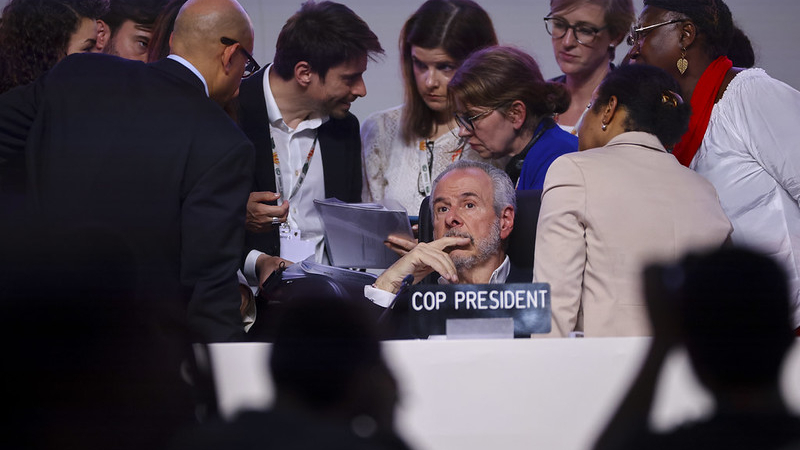
Drawing the proceeds in Brazil to a close, COP30 President André Corrêa do Lago concluded, “As we leave Belém, this moment must not be remembered as the end of a conference, but as the beginning of a decade of turning the game”.