Germany’s federal election - can the country salvage its energy transition?
Europe’s largest economy is heading to the polls this Sunday, how will the election impact the nation’s road to net zero?
Germany as a nation is not particularly well adapted to coping with change. If you were to drive down the German Autobahn (motorway), which still has no speed limits across wide stretches, and you turned up the radio, you would find yourself listening to music from the 1980s or 1990s. While diesel cars on German motorways are still pacing ahead without speed restrictions, the nation’s much-touted Energiewende (energy transition) is evolving at the pace of German musical preferences. In other words, it is rather slow to adapt.
Having pledged to meet net zero targets in 2016, it took a further five years for these ambitions to be turned into law. Germany, which is home to a population of more than 80 million and has a GDP of €4.5trn, is now required by law to become carbon neutral by 2045. Yet its so-called traffic light coalition of Social Democrats, Greens, and Liberals has faced unbridgeable rifts, in large part due to disagreements on how to tackle climate change. The economically liberal FDP has historically been sceptical of regulation on net zero, prompting some Germans to rebrand the acronym as the "Fahr doch Porsche" (ride your Porsche) party. Ideological divisions ultimately forced a rushed general election, due to be held on Sunday, 23 February.
The country has seen a shift to the right, with the conservative-leading Christian Democratic Union currently leading in the polls with some 30% of the vote and widely expected to enter a coalition with the Social Democratic SPD and the Greens. Yet the elephant in the room behind this centrist front is the far-right Alternative for Germany (AfD), which has seen its share of the vote surge to more than 20%. While the remaining parties have pledged to a “firewall” consensus not to enter into a coalition with the far right, the party, which has received public backing from Elon Musk and makes little effort to hide its sympathies for Germany’s Nazi past, has already succeeded in shifting the political discourse to the right.
“The urgency of tackling the climate crisis has been completely overshadowed by the migration debate. During election debates, the topic of climate change was barely mentioned,” shares Frank Huttel, head of portfolio management at Marburg-based FiNet Asset Management and co-founder of vividam, a sustainable robo-advisor. “Yet the climate crisis, and the fact that large swathes of the African continent will soon be uninhabitable, is precisely the reason why we will see a surge in migration,” he cautions.
U-turn ahead
If elected, the Conservative party is expected to reverse significant climate reforms put in place by its predecessors. While CDU leader Friedrich Merz is not denying climate change, he has, during the election period, indicated his distaste for wind turbines, describing them as “ugly” devices that should be dismantled and are more of an “interim” solution. Over the long run, the CDU places its hopes on nuclear fusion, a technology that energy experts warn is not advanced enough to be scaled up in time to meet Germany’s 2045 net zero targets. This lack of policy direction could pose a real challenge for long-term investors needed to fund infrastructure, Huttel warns.
While the CDU last year considered reviving the nation’s nuclear energy sector, Merz has now publicly acknowledged that the chances of reviving nuclear reactors are weak. Germany pledged to phase out nuclear energy in 2011, with the last reactor shutting down in 2023. “No insurer is now willing to underwrite the risks of these reactors,” argues Huttel.
Merz has also expressed criticism of Germany’s implementation of the new European Corporate Sustainability Due Diligence Directive (CSDDD), to be implemented under the catchy name of Lieferkettensorgfaltspflichtengesetz. Merz and his conservatives have made it a key priority to dismantle the new legislation, describing it as bureaucratic overload. The legislation imposes a “duty of care” on emitting companies to address emissions and environmental damage in their supply chains.
In a crucial move for the German car industry, Merz is also expected to reverse a ban on the manufacturing of internal combustion engines, which were due to cease production in 2035. Instead, the CDU states that its preferred mechanism for reducing emissions is the introduction of a higher carbon price, which would, over time, be increased to incentivise producers and consumers to shift away from higher-emitting products.
An economy in crisis
Yet there are hard economic reasons why Germany might want to pay greater attention to its energy transition. While '80s pop bands such as Nena and Alphaville might succeed in staying forever young, internal combustion engines won’t.
The German manufacturing sector is now in crisis. Demand for Germany’s manufactured goods has dropped by more than 8% since 2000, a trend expected to be amplified by the imposition of US tariffs. Meanwhile, German car manufacturers have been slow to adapt to the shift to EVs and are struggling to compete with Chinese peers.
Consequently, share prices of car giants such as VW, Mercedes, and BMW, once the backbone of German manufacturing, have plummeted. Reviving the automotive sector will be key to restoring the German economy, argues Michael Field, chief equity strategist at Morningstar. “Germany has the highest average labour costs in the automotive industry across Europe. Salaries in the auto sector, on average, are more than double the country’s average. We believe this sector's disproportionate contribution to the wage tax base in Germany makes preserving jobs in the auto sector strategically important from a political point of view,” he states.
“The majority of German OEM production plants across developed markets have already been transitioned to producing new energy vehicles, be it hybrid or battery-electric. For the German auto industry to prosper, we believe policy needs to be collectively supportive of electric car adoption,” he stresses.
Investor responses
But how are investors grappling with these challenges? Are they willing to fund the nation’s energy transition at a time when even the German economy is struggling with rising borrowing costs?
“All parties seem to have realised that they will win votes if they bash the climate agenda. There is a real lack of communication on the potential economic benefits of the energy transition,” criticises Christoph Klein, founder and managing partner at German manager ESG Portfolio Management. This translates into growing scepticism of ESG funds, particularly among retail investors, he argues.
Meanwhile, many institutional investors are concerned about the lack of policy certainty and are unwilling to take on the risks of significant private market exposures. “When it comes to investing in the energy transition, German pension funds are 20 years behind their peers in the Nordics, Netherlands, or the UK,” Klein criticises.
This could, in part, be down to a lack of scale. Compared to its European peers, the German pensions landscape is relatively fragmented, including a vast number of smaller pension funds. While insurers play a dominant role in the German institutional market, many cite Solvency II capital requirements as a potential obstacle.
Both Klein and Huttel identify German family offices as a force more ready to commit to the energy transition. “We are seeing a lot more long-term thinking and willingness to invest in renewables among family offices. Many are now led by a younger generation committed to tackling climate change,” Klein argues.
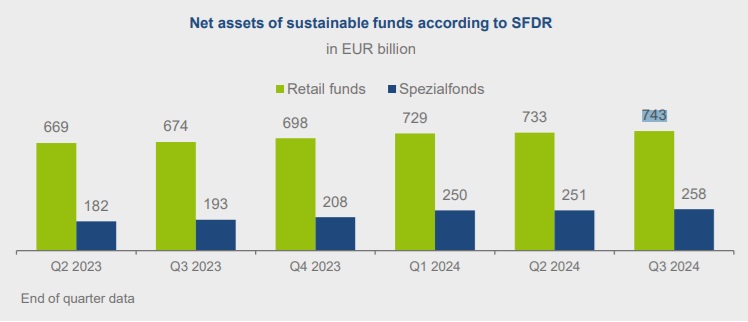
Indeed, despite the rather gloomy picture, data from the German investment funds industry BVI shows that investor demand for sustainably labelled funds is not slowing down. SFDR funds reported some €743bn in net assets in Q3 2024, with Spezialfonds the vehicle used by institutional investors adding a further €2258bn, a significant YOY increase, BVI data show.
New drivers
Huttel still sees significant investment opportunities in clean energy infrastructure, particularly in battery and clean energy storage capacity, which so far lags behind the rapid development of Germany’s photovoltaic and wind energy sector.
Klein instead emphasises that corporates will increasingly consider litigation risks, this could become a powerful lever to tackle emissions, he believes. Another factor could be insurers, who are now increasingly reluctant to underwrite fossil fuel projects.
While Germany’s future may be uncertain ahead of Sunday’s ballot, there is still reason for hope.