How would financial markets work in a steady state economy?
Part V of NZI’s Economy of the Future series explores the implications of a steady state economy for financial markets
The perpetual growth economic model acts as a safety net for investors. Whatever disruptions or crises wreak havoc in the short-term, the long-term trend of continued growth helps protect overall returns.
While the 2000s was a painful decade for investors, the 2010s featured the longest bull market in history as it landed on the right side of the boom-and-bust cycle and took advantage of ultra-low interest rates.
Environmental crisis, inflation, and rising interest rates could paint a very different picture for the 2020s.
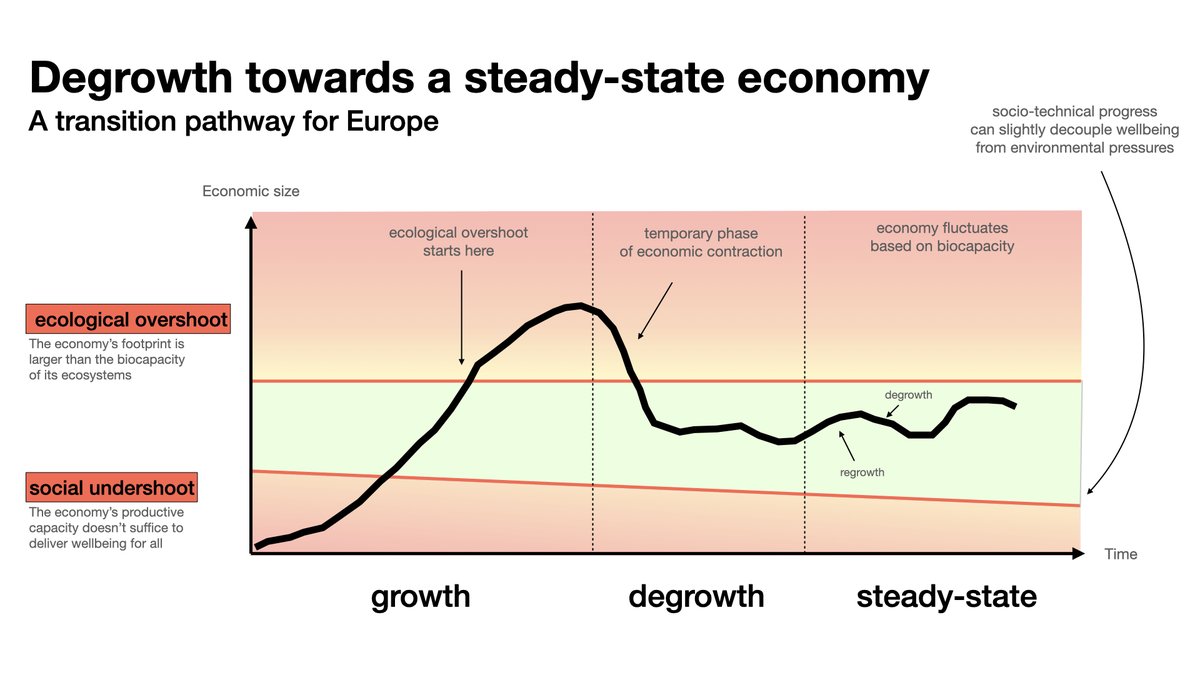
Some environmental economists argue that the planet’s limited resources simply can’t sustain endless growth, and that a “steady state economy” – one that doesn’t grow but remains within planetary boundaries – is the end game for sustainability.
Kate Raworth’s famous “doughnut economy” is a version of a steady-state economy.
The influential environmental economist Timothy Parrique also advocates for degrowth towards a steady state economy.
What does this mean for asset owners?
A steady state economy would have profound implications for asset owners. Without the aforementioned growth safety net, investments may become more of a zero-sum game.
“The system has been rigged for decades,” said Brian Czech, executive director of the Center for the Advancement of the Steady State Economy. “All investors had to do was throw money into a mutual fund, and then, with the policy machinery set for 3% GDP growth, it was all winners on Wall Street. That approach won’t work in a steady state economy.”
A stock market in a steady-state economy would have more losers than in the high-growth decades, he added. To succeed, investors need to be smart and “pick the winners”.
The amount of ideological resistance to a steady state economy is unsurprising, given the implications of this challenging environment. “Big money, the stock market, political and financial stability depend on GDP growing each year,” Czech added. “Nobody in the mainstream wants to imagine an alternative.”
Czech argued that the 21st century is likely to be an “age of supply shocks” due to on-going ecological collapse. This could enforce a hard ceiling to GDP growth, regardless of what policymakers and economists think or want.
Environmental economist Rudi Kurz said a no-growth economy is already here for certain developed nations, as underlined by the sluggish long-term growth forecast for European nations. “While European politicians strive to make growth happen again, through policy instruments, subsidies, and other means, there are limits to resources, such as labour and capital, especially natural capital. European economies may not grow at all in the next twenty years.”
A stable and predictable investment environment
While a steady state economy may create more of a zero-sum game for investors, if implemented carefully, it could also create a more stable and predictable economic environment.
Policymakers would need to focus on stabilising the cost of goods and services to make such an economy viable, Jacqueline Jackson, head of responsible investment at London CIV, told Net Zero Investor.
“One of the main reasons we need growth is to absorb increases in costs,” she said. As life expectancies increase, pension schemes – especially defined benefit plans – face increasing liabilities. This, in turn, puts extra pressure on pension funds to deliver returns.
However, if “proper social equity policy and approaches were implemented, and existing wealth was distributed in a more equitable way, the need to grow to cover ever rising costs would not be so great”.
“The growth model has been praised for lifting millions out of poverty, but it relies on infinite growth and infinite natural capital,” Jackson added. “This seems to overlook the fact that nature and resources are not infinite. We have to change how we think about prosperity.”
Less finance
Hans Stegeman, chief economist at Triodos, said the growth imperative is larger when there is more leverage in the system, as more profit is needed to pay off debts and interest.
“Finance would have to shrink in a steady-state economy,” he said.
At a practical level, activities that need to ‘degrow’, such as fossil fuels, wouldn't receive any finance. More generally, balance sheets would also have to shrink: fewer loans implies lower interest payments, which implies less need for growth.
A steady state economy would also require a fundamental shift in mindset from asset owners in terms of the returns they would expect from their investments.
“There's still a place for interest rates, money creation and finance in a post-growth society, but they would align with an economy that does not have to grow at the macro level,” he said. “That's fundamentally different to how the economy, finance, and investment currently works.”
__________________________________________________________________________________________________________________________________________
Also read The Economy of the Future series:
Net zero policies and transition risks - 'Asset owners should prepare for 20 volatile years'
How to navigate the profit problem in sustainability
Are green growth and degrowth really so different?
__________________________________________________________________________________________________________________________________________