NZI Annual Conference- tackling the real impact challenge
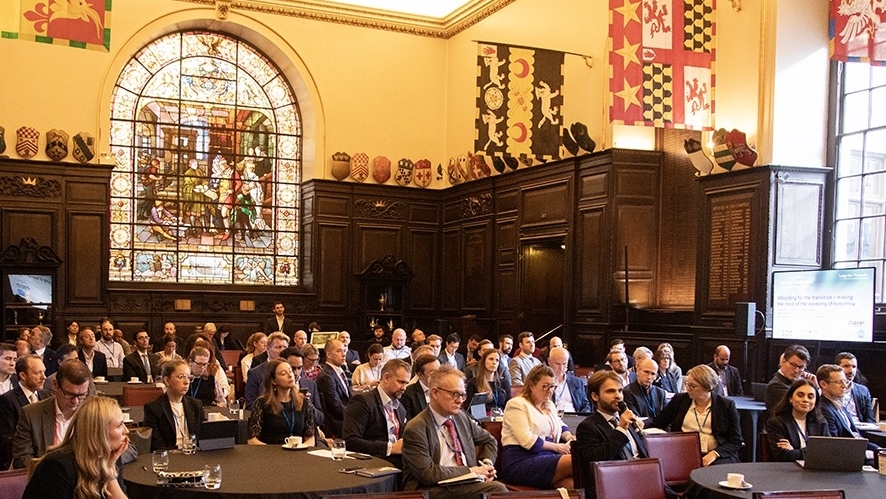
Net Zero Investor’s Annual Conference at Stationer’s Hall drew a full room of delegates to take stock of the key opportunities of the energy transition
Natalie Winterfrost, director of Law Debenture and chair of Net Zero Investor’s Annual Conference, opened the event by emphasising a key theme: "real-world impact". Addressing delegates, she underlined the political backdrop, noting the UK's new Labour government and welcoming its commitment to promoting credible transition plans.
However, Winterfrost acknowledged the uncertainty ahead, with the US election just two weeks away. She expressed concern about the troubling atmosphere in the US, where some asset managers still view net zero investing as an ethical issue rather than a financial imperative.
She also pointed out that in the UK, the Financial Markets Law Committee’s guidance on fiduciary duty in relation to climate change had provided more clarity on the financial materiality of these challenges.
UK climate tech
David Gudgin, chair of Elbow Beach, delivered the first keynote, noting that while the UK has more climate technology companies per capita than both the US and the EU, it lags behind in investment.
Gudgin stressed the need to scale up these sectors, warning that the cumulative impact of CO2 poses a significant challenge. He pointed to infrastructure investment as a critical lever for accelerating growth in these industries.
Allocating to the transition: making the most of the energy of tomorrow
The first panel session explored new strategies for allocating to the energy transition. Hilkka Komulainen, speaking from a defined contribution (DC) perspective, explained that Aegon has started by screening its listed passive portfolios but is now expanding into private assets.
Komulainen highlighted the challenges for DC providers in balancing the performance of their strategies with carbon reduction targets in a highly competitive market.
Anastasia Guha criticised overly prescriptive approaches to decarbonisation, such as a generic target to reduce emissions by 7% per annum, regardless of the sectoral allocation of the fund. She also highlighted the difficulties for passive investors in reducing real-world emissions, noting that some of the largest index constituents in developed market indices have made little progress on carbon reduction.
“We have all set net zero targets, but we didn’t really think through what would happen if the beta of the markets is going in the opposite direction? What do you do? How long does your resolve last?” she challenged the panel.
Thomas Leys, investment director at abrdn Investments, picked up on this, warning that investors focusing solely on reducing the Scope 1 and 2 carbon footprint of their portfolios could inadvertently shift money to banks funding the fossil fuel sector. “Understanding why you are holding an asset is important,” he emphasised.
Leys also acknowledged that stewardship options in fixed income are limited, with divestment often having little impact as bonds are heavily oversubscribed. However, he stressed the importance of providing feedback to issuers.
'New ideas, new models, and new asset allocation'
Julien Halfon, head of pension solutions at BNP Paribas Asset Management, opened the second panel by stating that asset owners must evolve in different ways to seize the opportunities of the energy transition.
“New ideas, new models, and new asset allocation” are required, he explained, adding that traditional investment approaches, such as the 60:40 model, are inadequate for accessing the energy transition. Investors need to adopt a more thematic approach.
Mark Lyon, deputy chief investment officer at the £49bn Border to Coast Pensions Partnership, discussed the Local Government Pension Scheme (LGPS) pool’s first thematic fund—the Climate Opportunities Fund. Lyon explained that this fund was developed in response to partner funds seeking exposure to net zero commitments beyond infrastructure investments. Initially, the offering faced challenges, particularly regarding how to categorise natural capital within their asset allocation. However, Lyon noted that conversations were smoother when it came to their UK Opportunities Fund.
Rosalind Smith-Maxwell, director at Quinbrook Infrastructure Partners, echoed these sentiments, expressing empathy for asset allocators. She pointed out that natural capital can be categorised in various ways, from venture capital to private equity, making it challenging to fit into traditional models.
Smith-Maxwell also highlighted the UK's need for £525bn of investment to deliver 100% renewable energy, especially as demand surges due to the rise of data centres. She emphasised that this is not “tomorrow’s problem,” but one that needs immediate action.
Joe Shamash, investment director at Better Society Capital, concluded the panel by calling for stronger partnerships between investors and the government to build carbon markets and promote investments in UK infrastructure.
The National Wealth Fund: underinvestment challenges
Wrapping up the morning’s discussions, Jonathan Pollock, co-founder and CEO of Elbow Beach, the event’s lead sponsor, sat down with Steven Penketh, senior adviser at the Green Finance Institute, to discuss how the newly launched UK National Wealth Fund could help close the execution gap in transition infrastructure projects.
The National Wealth Fund was launched shortly after the Labour Party came to power in July, with an £8bn government commitment aimed at attracting private investment in UK infrastructure and the energy transition. Earlier this month, Rachel Reeves announced that the UK Infrastructure Bank will merge with the fund, bringing its total assets to over £22bn.
Penketh acknowledged that the current UK administration has inherited the problems of underinvestment and constrained public finances, meaning the lion’s share of investment would need to come from the private sector.
He argued that the public sector lacks the expertise to facilitate capital flows and assess risks. He suggested that blended finance or concessional capital could play a crucial role in bridging the gap.
Penketh also highlighted that many public firms and institutions are not involved in origination, leaving the onus on investors. This, he said, is a key reason why the acceleration of energy transition investments has been slow.
Despite these challenges, Penketh expressed optimism about the launch of the National Wealth Fund, urging policymakers to view any spending on the energy transition as an investment rather than a cost.
Carbon credits: learning from mistakes, new tailwinds
The next panel focused on nature-positive investing, with discussions centred on biodiversity, carbon credits, and natural capital. Delivering a stark message to the audience, Alex Godfrey, investment director at Octopus Investments, warned that nature and climate are in crisis, which will ultimately pose a risk to investors’ balance sheets and portfolios in the future.
“No one will reach net zero without carbon credits, and so far, they have been a failure,” Godfrey told delegates, stressing that investors should concentrate on building up the integrity of the carbon credit market.
Marc Barnett, head of investment at £2.3bn Natwest Cushon Master Trust, echoed Godfrey’s sentiments, noting that there have been enormous tailwinds for carbon credits, with sophisticated corporates now looking to secure projects to ensure a pipeline of high-integrity carbon offsets for the future.
Greg Munford, senior investment strategist for sustainable investment at the £40bn New Zealand Superannuation Fund, highlighted key barriers to scaling up investment in the natural capital space, including market uncertainty and the fact that nature-based risks are not being properly priced.
“For us, there are opportunities, but they are often small investments with relatively high transaction costs due to their complexity,” he said.
Olly Hughes, managing director of forestry at Gresham House, provided an overview of the markets, explaining that the voluntary sector has not developed “particularly well”, remaining very small. Meanwhile, the compliance carbon sector, though having only two “successful markets” such as New Zealand’s, has been established for a long time and has seen success.
“The voluntary sector, to be blunt, is a bit of a shambles, but what we are proposing is that we learn from some of the mistakes in the carbon markets as the biodiversity sector evolves.”
Clean Growth case studies
Beverley Gower-Jones founder and managing partner Clean Growth Fund grabbed the audience's attention with a broad range of case studies illustrating the need to scale up climate solutions. This ranged from finding alternatives to palm oil, which still features in half of all products stored in UK supermarkets to replacing crude oil in consumer products, which according to is was harder than phasing it out in the energy sector. "We urgently need to scale up climate solutions" she warned.
"As the Unilever's and Kraft-Heinz' of this world decarbonise their supply chains, the solutions they need won’t be ready and their share prices will come falling down" she warned. "Everybody talks about engagement but the other piece of the puzzle is investment in the venture capital these companies need to provide the solutions" Gower-Jones added. Examples range from firms using fermented oil as a substitute for palm oil to industrial fermentation to produce biobased surfactants replacing petrochemicals in many consumer products.
Index investing: no more rear-mirror view
Turning to the role of index-based investors in the energy transition, Joanna Sharples, CIO DC solutions at Aon, and Callum Stewart, head of investment proposition distribution at Standard Life, discussed how index investors can avoid a backward-looking approach to climate change and decarbonisation.
Sharples began by acknowledging the progress index investors have made: “Coming from a place where it was all about exclusion and tilting, indices have become much more sophisticated. The big challenge for us now is real-world impact,” she said.
Stewart echoed her views but warned that the sheer volume of data index providers are managing has reached a point where the marginal benefits of adding more data are diminishing. Sharples suggested that AI could play an important role in filtering out the most relevant information.
Both panellists were asked whether their assessments of companies should include Scope 3 emissions, in addition to Scope 1 and 2. Sharples and Stewart argued that, for now, they prefer to focus on Scope 1 and 2 emissions, as Scope 3 data remains subjective and inconsistent.
Stewart added that, to adopt a more forward-looking approach, Standard Life collaborates with the Transition Pathway Initiative to assess companies' transition strategies and increase exposure to those with more realistic plans.