Real estate managers in the spotlight: how are they scoring on climate?
With institutional interest in real estate rising, how are managers performing on climate? A new report sheds further light
While real estate has long been a cornerstone of many institutional portfolios, recent reductions in central bank interest rates in Europe and the UK have provided a potential boost for the asset class. But for climate-focused investors with net zero pledges in place, gauging the carbon footprint and transition readiness of their portfolios remains a complex challenge.
In person: NZI Real Estate Summit | 16 September | London | Find out more here
Real estate accounts for around 40% of global carbon emissions, and with building materials such as cement, steel, aluminium and glass being carbon-intensive to produce, the sector has been notoriously hard to decarbonise.
A new study by ShareAction compares the climate credentials of 16 of the world’s largest real estate managers, which together manage a combined $1.66 trillion in property. The research reveals significant discrepancies: Danish real estate specialist Nrep ticks all the boxes, while the bottom three managers – Blackstone, Starwood Capital Group and Greystar – fail to meet any of the requirements.
Other relatively high-scoring managers include Savills Investment Management, Patrizia and Heimstaden. The study ranks managers on 12 key criteria, ranging from target setting to decarbonisation strategies and disclosures.
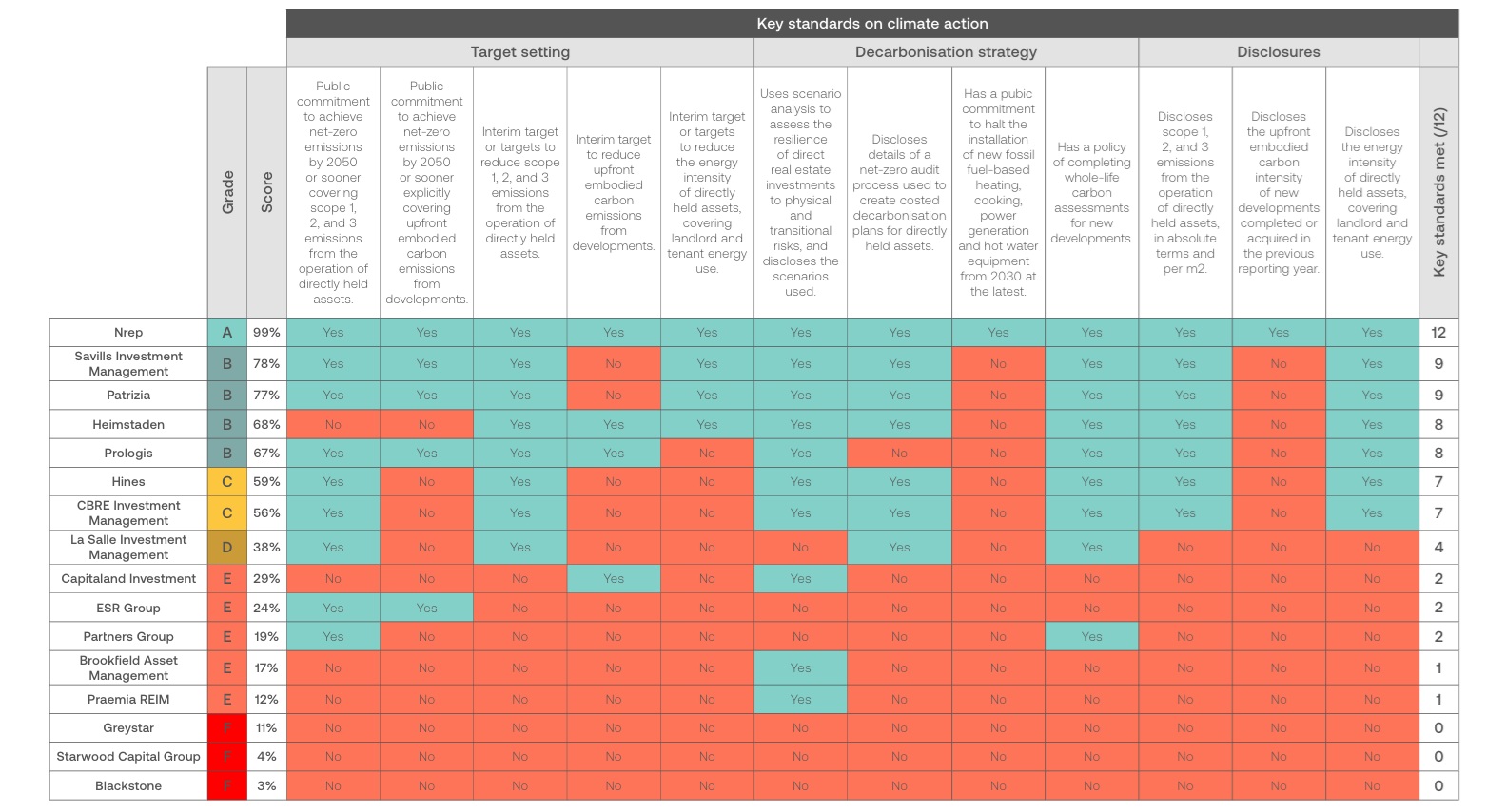
Only five of those surveyed have an interim target to reduce upfront embodied carbon emissions from developments. Meanwhile, only four have an interim target to reduce the energy intensity of directly held assets, covering both landlord and tenant energy use.
Notably, just one manager – Nrep – has a public commitment to halt the installation of new fossil fuel-based heating, cooking, power generation and hot water equipment from 2030 at the latest.
Aidan Shilson-Thomas, senior research manager at ShareAction, commented: Some of the world’s largest real estate investment managers are failing to act on climate change at a time when rapid action is needed. The construction and operation of buildings account for a staggering third of global emissions, creating financial risks that managers must take seriously. The asset owners they act on behalf of, including pension funds, are relying on them to do so.
Industry responses
Net Zero Investor approached the highest- and lowest-scoring managers for comment.
Elisabeth Hermann Frederiksen, head of sustainability at Urban Partners – the investment manager that includes Nrep – welcomed the report: We applaud the transparency that ShareAction is offering to climate strategies across major real estate managers. We thrive on growing the energy- and carbon-efficient real estate market, and our climate strategy allows us to align short- and long-term investor, city and tenant interests. We currently work with an average ROI across operational emissions reduction actions of 10% – turning decarbonisation actions into commercial opportunities like this is how we reach scale.
Paul Spina, COO at Heimstaden, also expressed his support: We are proud of this recognition, and to be viewed among our best-performing peers when it comes to sustainability. This reflects our commitment to transparency and sustainable progress. Meeting eight of twelve key standards shows we are on the right path, but we recognise there’s always more to do, and we are determined to keep raising the bar.
Greystar, which scored relatively poorly in the report, said it remains committed to reducing the environmental impact of real estate and delivering more resilient, sustainable homes for its residents: We are a vertically integrated residential real estate business, which means we design, develop, own and operate our communities over the long term. This gives us a strong commercial and social incentive to future-proof our buildings and embed sustainability at every stage.
The firm has committed to achieving net zero operational carbon emissions by 2040 for landlord-controlled areas, and is targeting a 25% reduction in energy intensity and a 20% reduction in on-site water usage by 2030.
It added: We continue to evolve our strategy in line with global best practice and work with others across the sector to improve data quality and transparency. However, we believe ESG assessments should reflect not only disclosure but also delivery, as well as the structural differences between asset classes, ownership models and regulatory frameworks.
The report marks ShareAction’s first attempt at grappling with the real estate sector’s carbon footprint, with decarbonisation targets notoriously hard to compare. One key challenge is that managers pursue very different approaches: vertically integrated real estate managers control multiple aspects of development in-house, while others – such as REITs – outsource more of the process. This makes it harder to compare carbon footprints.
Moreover, disclosure of carbon footprints in residential real estate can be more complex than in commercial properties, with some required information subject to GDPR restrictions.