Stewardship at a crossroads: should investors target policy or companies?
Is the path to net zero through corporate engagement or policy reform?
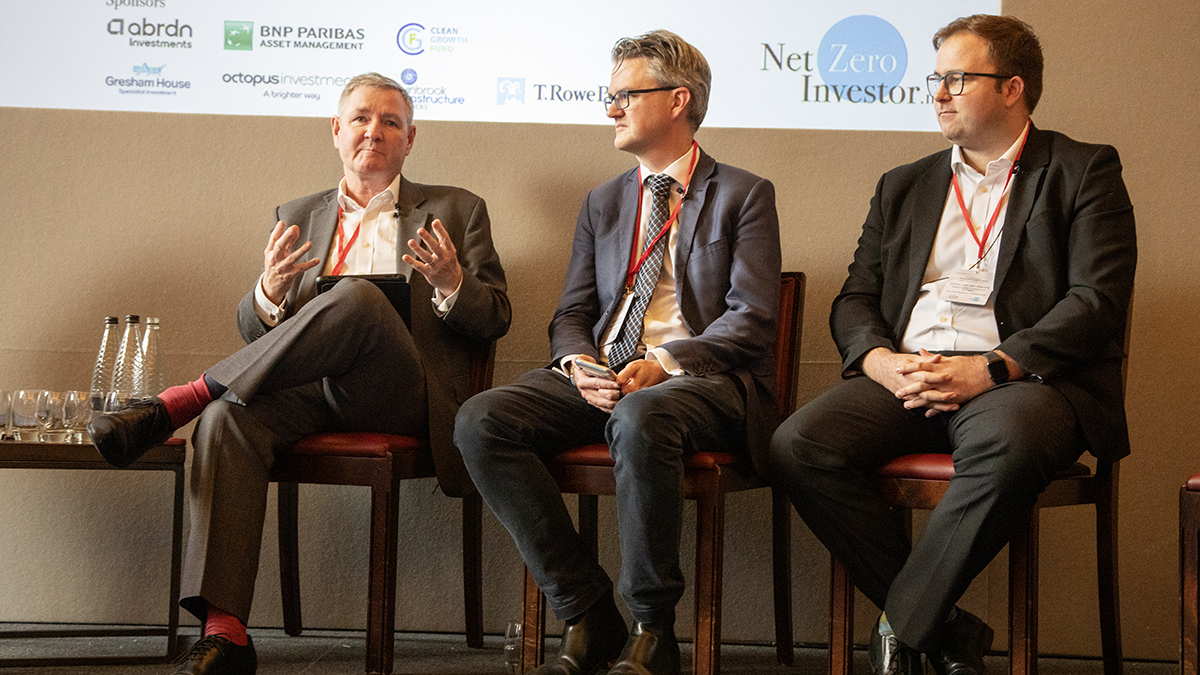
At Net Zero Investor’s third annual conference in London, speakers debated whether investors should prioritise engagement with companies or policy makers, ultimately suggesting that “climate change is policy change”.
Addressing delegates at Stationers’ Hall in London, Keith Guthrie, head of sustainability at the £4.8bn UK master trust NOW:Pensions, shared that following years of stewardship with companies, including oil and gas, the fund has decided to “move away from individual companies and start focusing on policy engagement”.
Guthrie acknowledged that policy engagement is not “easy to figure out” but said that “collaboration is at the forefront of our push here.”
The announcement follows NOW:Pensions’ recent update to its investment strategy last week, with its equity allocations now managed directly by the scheme’s in-house investment manager Cardano Risk Management. This allows the master trust to have direct engagement and influence on its company holdings.
Chris van der Merwe, responsible investment manager at the £30.8bn UK Local Government Pension Scheme (LGPS) pool Brunel Pension Partnership, added: “There is of course value from company engagement, but at some point, the policy and regulation [engagement] will move the market forward.”
‘Climate change is policy change’
Offering a slightly different perspective, David Russell, chair of Transition Pathway Initiative, argued: “The reality is, it has to be both”.
“But, to be blunt, climate change is policy change. We can engage as much as we like with individual companies, but in the end, the solution to climate change will be driven by policy change across different markets around the world.
“It can’t just be in the UK or in Europe; it must be a global thing,” he told delegates.
Russell further explained that “more investors must be involved in getting that policy to change”, but argued that “writing letters to government doesn’t do it”.
“Reading the room does it, getting the right people in the room might do it as well,” he added.
CA100+ setback
The speakers agreed that collaborative engagement, such as through Climate Action 100+ (CA100+), is a keyway for investors to influence policy change. Chris van der Merwe highlighted that “the issue we face is systemic, and we need to make sure we are speaking with one voice.”
But speakers also acknowledged the recent setbacks to the ambitions of CA100+, with JPMorgan Asset Management and State Street Global Advisors leaving the group, while BlackRock withdrew its US arm.
Russell said: “Shoutout to BlackRock, who only left with half of their money - bear in mind they were going to leave entirely, and their action was only from the engagement of asset owners, who encouraged them to stay with their international money”.
Despite these exits, Russell noted that “more funds have joined CA100+ over the past year, than have left”, with the alliance’s recent benchmark showing that the initiative has taken on 90 new joiners since June 2023.
However, the chair of the TPI argued that some changes are needed in CA100+ focus. “My personal view is that focusing on oil and gas companies, the supply side that is, hasn’t really got us that far,” he said. Instead, the attention of the alliance should be on the demand side, targeting the consumption of oil and gas, Russell added. “If you stop the demand, the emissions will go,” he concluded.