
UK green funding skewed towards fossil fuel-backed technologies
New data reveals the UK will spend more than double on carbon capture and hydrogen than all other emerging cleantech, sparking concerns over fossil fuel influence and transparency
A new data investigation by Net Zero Investor reveals a stark imbalance in the UK’s green spending: between 2025 and 2030, around £9.8bn is set aside for carbon capture, utilisation and storage (CCUS) and hydrogen—more than twice the £4bn allocated for cleantech startups, and eclipsing the £5.1bn earmarked for nature projects.
This uneven distribution, investors warn, suggests an undue influence by fossil fuel interests on the nation’s net zero agenda—a situation that raises serious questions about transparency and the effective use of finite public funds in driving a decarbonisation programme.
Creating an enabling policy environment requires sending clear policy signals; this has been achieved for CCUS and hydrogen, but not for other emerging solutions, which could, in the long-run, offer much better value for money, investors say.
While clear spending projections for CCUS and hydrogen are readily available, the same is not true for other early-stage clean technologies, which are buried amid a confusing array of proposals. The government’s opaque reporting practices have left investors grappling with vague data where terms like “innovation” too often include CCUS and hydrogen.
The data investigation
By making spending plans for the different parts of the net zero value chain comparable, Net Zero Investor's data investigation aims to shine a light on what the UK's green finance agenda is achieving.
The idea for the investigation came when cleantech VCs told NZI on background that they worry that the UK government is sending money to the wrong places, pursuing white elephants like CCUS and hydrogen at the expense of other emerging decarbonisation solutions that don’t require fossil fuels.
This research seems to confirm that hypothesis.
The oil and gas industry is a vocal proponent of CCUS and hydrogen because they enable more fossil fuels to be burnt for longer. Meanwhile, cleantech startups directly challenge fossil fuel interests, as they tend to promote fossil-fuel-free decarbonisation pathways.
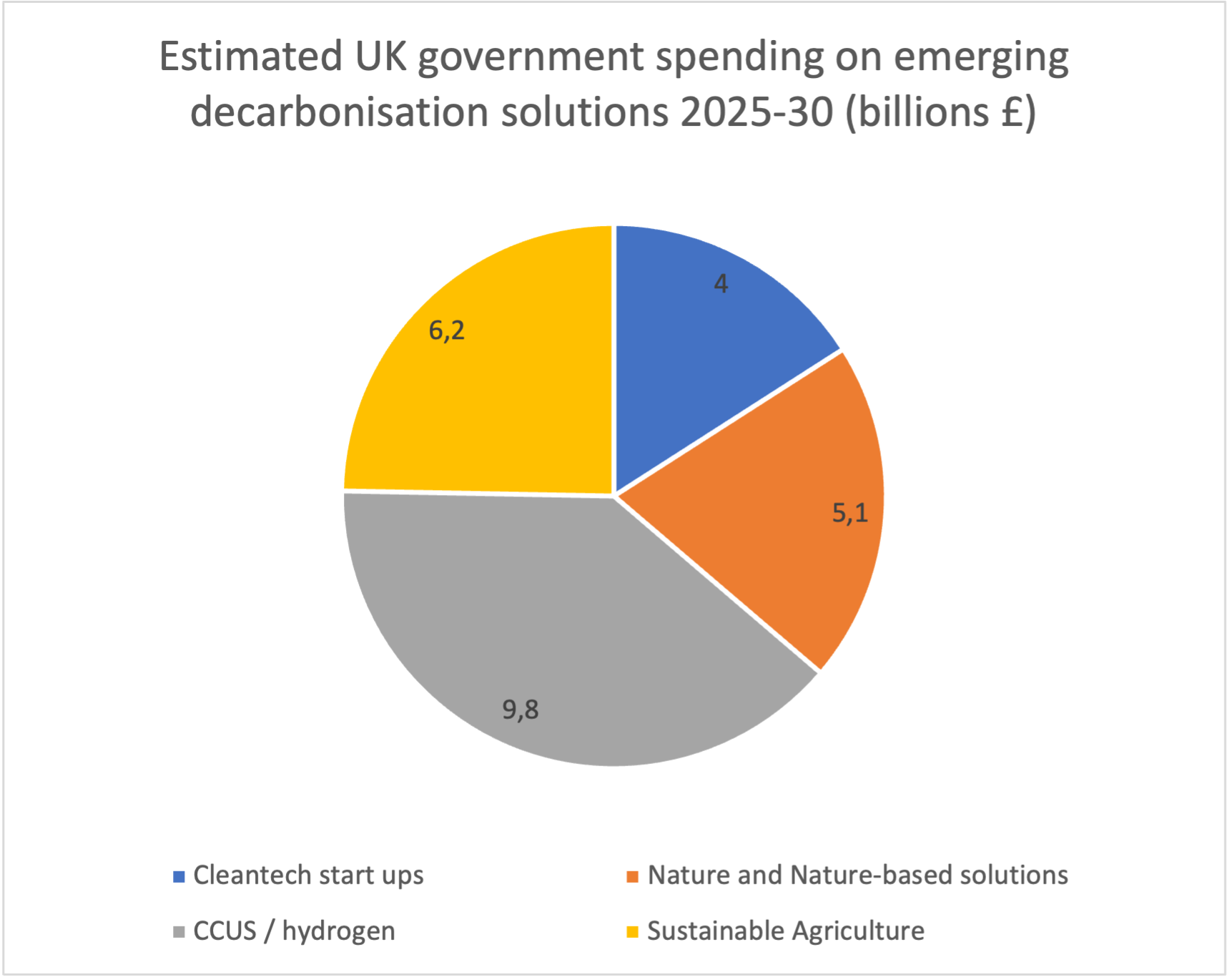

The pie chart shows that the UK has positioned CCUS as a cornerstone of its industrial decarbonisation strategy. The government has committed £21.7bn over the next 25 years, and £3.9bn in the next two years alone. The front-loaded spending plan is logical given the capital intensive nature of building the largely unproven technology. Net Zero Investor expanded on the £3.9bn figure to reach the £9.8bn over five years estimate.
The funding includes a mix of direct Exchequer contributions (25%) and consumer levies (75%), with the latter drawing criticism due to its impact on already high energy bills. The first operational CCUS clusters—HyNet and East Coast—are expected to begin operations in 2028, two years behind schedule.
But even this massive number (£9.8bn) could balloon in the coming years, if the government green lights other projects, according to Carbon Tracker. The widely quoted £22bn over 25 years is just for the first five projects.
"The government isn't taking a strategic enough approach to CCUS," said Carbon Tracker analyst Rich Collett-White. "These complex, first-of-a-kind projects require complex, bespoke engineering, making them extremely expensive and dependent on large amounts of public money. CCUS is currently set to receive far more government support than it merits and in the wrong sectors. The government should focus more on value for money or there is a serious risk of stranded assets and higher electricity prices for limited climate benefit."
KEY FINDING: The preference for CCUS and hydrogen comes at the expense of other emerging technologies
Green Angel Syndicate invests in deep-tech decarbonisation solutions such as the Durham University spin-off Low Carbon Materials, which makes carbon negative alternatives for building materials like concrete and asphalt.
Its founder and chairman, Simon Acland, told Net Zero Investor that early-stage companies often struggle to raise sufficient capital to go from proof-of-concept to building their first factory and getting their product to market.
"We have considered various companies developing fossil-fuel-free cement technologies," he said. "However, we are nervous about making an investment because we know they will be very capital intensive."
Although Green Angel Syndicate could provide the "first few million", there’s no clarity on where the next 100m would come from to build their first plant, he explained. He would therefore welcome "more clarity" around which types of projects will receive funding from "the UK Infrastructure Bank".
With today's technology, even CCUS critics admit that cement is one of the clearest use-cases for CCUS: a hard-to-abate sector with no alternative decarbonisation pathway. Yet hard-to-abate is shifting sand: what seems impossible today, is the industry norm tomorrow. If an innovative company found a cost-competitive way of producing cement without fossil fuels, then the bottom would fall out of the CCUS industry, making the current government’s “prioritisation” of the sector a costly mistake and a misuse of public money.
In other words, even cement - the poster child for CCUS - provides no long-term guarantees for the technology, but with so much funding being allocated to CCUS and comparatively little (exact figure unknown) earmarked for innovation around fossil-fuel-free cement, the government is placing a lot of public money in a single, risky basket.

Green Angel Syndicate takes the view that green technology must cost the same or less than the product it is replacing.
"Even if people want to do the right thing, most can't afford to pay a huge premium for a green product," Acland explained. "You'll get a few better off motivated early adopters, but for the mass market you have to give people the same or better for less."
Therefore, he has "grave doubts" about green hydrogen opportunities, because the price will probably never equal grey or blue hydrogen. CCUS has the same problem: new innovative processes "are likely to be cheaper than old ones with CCUS attached”.
KEY FINDING: Investors need clarity on UK green spending
An enabling policy environment requires clarity on how the net zero transition will unfold across different sectors and which technologies will be prioritised.
"Some of our members often note that the government announces spending targets for clean technologies but provides little clarity as to how much has actually been committed, how much comes from existing pots and how much is entirely new," said Oscar Warwick Thompson, head of policy and regulatory affairs at UK Sustainable Investment and Finance Association (UKSIF).
Clear policy signals are "essential" for supporting members’ efforts "to mobilise capital towards the transition", he added.
For example, in principle, UKSIF supports new public-private-partnerships such as GB Energy and the National Wealth Fund, which aim to use public money to catalyse private capital. This is especially important for emerging technologies that have yet to build an investable pipeline.
However, in practice, there are still "big question marks" over which sectors they will target and the potential for overlapping remits.
"Our members want clear and granular decarbonisation pathways for each sector," he added.
Carbon Tracker's Collett-White said he was "unsurprised" by the difficulties faced by Net Zero Investor in sifting through the various spending pledges to compile estimates for the different parts of the net zero value chain.
"Clean energy companies not involved in CCUS and hydrogen are frustrated with the government's green spending direction and overemphasis on technologies that will have a fairly limited role in the transition," he said.
KEY FINDING: UK Cleantech needs more support
Given that government spending for CCUS and hydrogen is likely to be double that earmarked for all other emerging technologies combined, it is unsurprising that VC cleantech funds have voiced concern to Net Zero Investor.
“The UK's green finance agenda seems to have been unduly influence by fossil fuel interests,” said one VC fund manager on background. “There have been big spending pledges, but the money is going to the wrong places, namely CCUS and hydrogen.”
Sarah Mackintosh, director at Cleantech UK, said Net Zero Investor's £4bn estimate for cleantech spending showed a need for the emerging technology to "benefit from the same policy clarity and market certainty as other government-backed technologies".
"With the US signalling a potential shift away from climate leadership, the UK has a chance to step up and strengthen its position as a global hub for cleantech investment," she said. "Expanding the innovation portfolio to further develop diverse cleantech technologies would accelerate decarbonisation, drive down costs, and unlock breakthroughs that could redefine today’s ‘hard-to-abate’ sectors."
DATA METHODOLOGY
There is a lack of clarity around government funding allocated to the various parts of the net zero value. This is partly due to the funding being spread across diverse, potentially overlapping initiatives, funding mechanisms and spending timelines. Another factor is that pledges tend to omit the finer details of the actual spending plans. For example, Innovate UK aims to support private sector investment in clean energy supply chains and climate tech across the UK, but “innovation” also includes hydrogen and CCUS investments. It is therefore unclear how much money will be allocated to cleantech start-ups as opposed to hydrogen and CCUS.
Given the aforementioned complexity in the data, together with significant data gaps, Net Zero Investor's estimates are intended only as ballpark figures.
How the figures were reached
1. CCUS and hydrogen: £9.8bn
The UK has positioned CCUS as a cornerstone of its industrial decarbonisation strategy, with £21.7bn committed over 25 years. This funding includes a mix of direct Exchequer contributions (25%) and consumer levies (75%). Initial targets aimed to capture 2030 million tonnes of CO2 annually (mtpa) by 2030, but this was revised downward in December 2024 due to delays in project deployment. The first operational CCUS clusters—HyNet and East Coast—are now expected to begin operations in 2028, two years behind schedule.
The 2024 Autumn budget includes £3.9bn of funding in 2025 and 2026 for CCUS Track-1 projects and contracts with 11 green hydrogen producers, or £1.95bn per year.
This is far above the £0.88bn per year average (21.7 ÷ 25 = 0.88). If the government spends the same in the 2027-30 period, then the total spend 2025-30 will be (1.95 x 5) £9.75bn
OTHER COSTS NOT FACTORED INTO THIS ESTIMATE
The government assumes significant commercial risks, including liability for undersea storage leaks and long-term revenue guarantees for emitters. Contingent liabilities for CCUS projects were valued at £14.3- £34.4bn in 2024. In the worst case scenario, the UK government could spend £44.15bn (9.75 + 34.4) on CCUS by 2030.
2. Grid Upgrades: £35bn
National Grid Investment: National Grid plans to invest up to £35bn over the five years from April 2026 to March 2031 in its electricity transmission business. The UK's Clean Power Action Plan requires doubling the current capacity on the grid within five years.
3. Renewables: £20bn
Given the critical role of renewables in the energy transition, it issurprising that spending on renewables was one of the hardest estimates to make (the hardest was cleantech startups). This is largely due to the complexity of the Contracts for Difference (CfD), which is the primary support mechanism for renewables. In addition, plans for reform of the CfD are likely to crystallise during 2025 with measures such as changes to eligibility, auction parameters and the length of the term under review. That said, the government has published several key documents that make an estimate feasible.
The most important of these is the Clean Power by 2030 plan, in which the government estimates clean power investment estimated to be around £40bn per year for the next 6 years. However, it is unclear how much of this money will be allocated to renewable energy (via CfD, for example) and how much to other “clean power” initiatives, which could include gas power stations equipped with CCUS and grid upgrades.
Therefore a rough estimate is £25bn per year for renewable energy and £15bn per year for other clean power initiatives seems reasonable, over a five year period, that adds up to £125bn. However, as this figure does not separate public from private investment, more research is needed.
The CfD scheme remains the cornerstone of public investment in renewables, guaranteeing stable revenue for developers through competitive auctions. Recent reforms aim to accelerate offshore wind deployment and address planning bottlenecks:
The AR6 auction (2024) allocated £1.5bn, with offshore wind receiving £1.1bn.
Proposed reforms for AR7 (2025) and subsequent rounds include extending contract terms to 20 years, increasing budgets, and streamlining planning consent. Over five years, CfD allocations are projected to total £8–10bn, assuming annual budgets of £1.6–2bn.
The state-owned energy company Great British Energy, launched in 2024, will channel £125m in 2025–26 to support community and local authority-led projects. Assuming annual funding escalates to £200m by 2030, cumulative spending could reach £800m–£1bn.
A £500m long-duration energy storage (LDES) subsidy scheme announced in 2024 aims to address intermittency challenges in renewables. With additional allocations likely, this could expand to £2–3bn by 2030.
To strengthen domestic manufacturing, the government introduced tax credits and grants for offshore wind supply chains in 2025. This initiative, including the Clean Industry Bonus, is projected to cost £1.5–2bn by 2030.
Floating offshore wind, tidal stream, and green hydrogen projects will receive £3–4bn in public funding. This builds on the £105m allocated to Pot 2 technologies in 2024. Take out green hydrogen from the equation, and this figure is closer to £1.5-2bn.
The government has earmarked £500m to streamline planning processes for offshore wind and solar farms. This includes hiring additional staff for consenting bodies and digitising environmental assessments.
In conclusion, excluding grid, hydrogen, and CCUS investments, the UK’s public renewable spending will rely on sustained CfD budgets and targeted storage subsidies. The £16–20bn range reflects cautious optimism but assumes no major fiscal shocks (e.g. the return of inflation). The £16–20bn estimate marks a 22% increase over the £13.1bn spent on renewables between 2020–2025 but remains below the £25bn analysts argue is needed to meet 2030 targets.
4. Cleantech start-ups: £4bn
The UK government is actively supporting cleantech start-ups through various funding mechanisms, such as targeted grant programmes, accelerators, and strategic funding initiatives. However, estimating the UK government's investment specifically in cleantech start-ups, excluding CCUS and hydrogen, for 2025-2030 is extremely challenging due to the lack of a specific overall figure and the fact that “innovation” investments tend to include hydrogen and CCUS.
The Net Zero Innovation Portfolio, a £1bn fund from 2021–2025, is expected to be renewed with adjustments to exclude hydrogen and CCUS. Allocations for cleantech startups could account for £800m–£1bn over 2025–2030. Key focus areas include:
Energy storage: Grants for long-duration storage technologies, such as advanced batteries and thermal systems.
Smart grid systems: Funding for AI-driven grid management tools and demand-response platforms
Innovate UK plans to allocate £1.2bn specifically for cleantech innovation from 2025, with £700–900m directed to startups in:
Decarbonising industry: Grants for circular economy solutions and material efficiency technologies
Renewable integration: Support for software platforms optimizing solar and wind deployment
While primarily for large-scale renewables, the CfD’s "Pot 2" for emerging technologies could allocate £300–500m to startups in floating offshore wind and tidal energy. Recent reforms prioritise "non-established" technologies, creating opportunities for innovative SMEs.
The Net Zero Technology Centre’s TechX Accelerator offers £50,000 grants per startup, with £500,000 allocated annually. Over five years, this could total £25–30m. Similar regional programmes, such as Wales’ HyBRID initiative, may contribute £50–70m collectively.
Ofgem’s £450m Strategic Innovation Fund, targeting grid decarbonisation, could channel £200–300m to startups developing smart metering and distributed energy solutions. Additional sector-specific grants (e.g., BEIS’s AI for Decarbonisation Programme) may add £150–200m.
The Enterprise Investment Scheme (EIS) serves as a critical enabler of startup (not just cleantech) growth in the UK, functioning as a tax incentive mechanism rather than a direct expenditure line.
Net Zero Investor estimates a £400-600m spend on cleantech start ups from 2025-30.
5. Nature, nature-based solutions, and sustainable agriculture: £5.1bn
The UK government has outlined various funding mechanisms for nature-based solutions and nature restoration projects.
Nature-Based Solutions for Climate Change Programme: £12.5m
Nature Restoration Fund (Scotland): £50m
Green Recovery Challenge Fund: £80m
Species Survival Fund: £25m
Natural England’s Species Recovery Programme: £18m
Forest Protection Commitment: £1.5bn
The total spend on these projects is approximately £1.686bn.
However, nature spending is also present in the 2025-30 agriculture budget, which is separate to the above mentioned projects (see below)
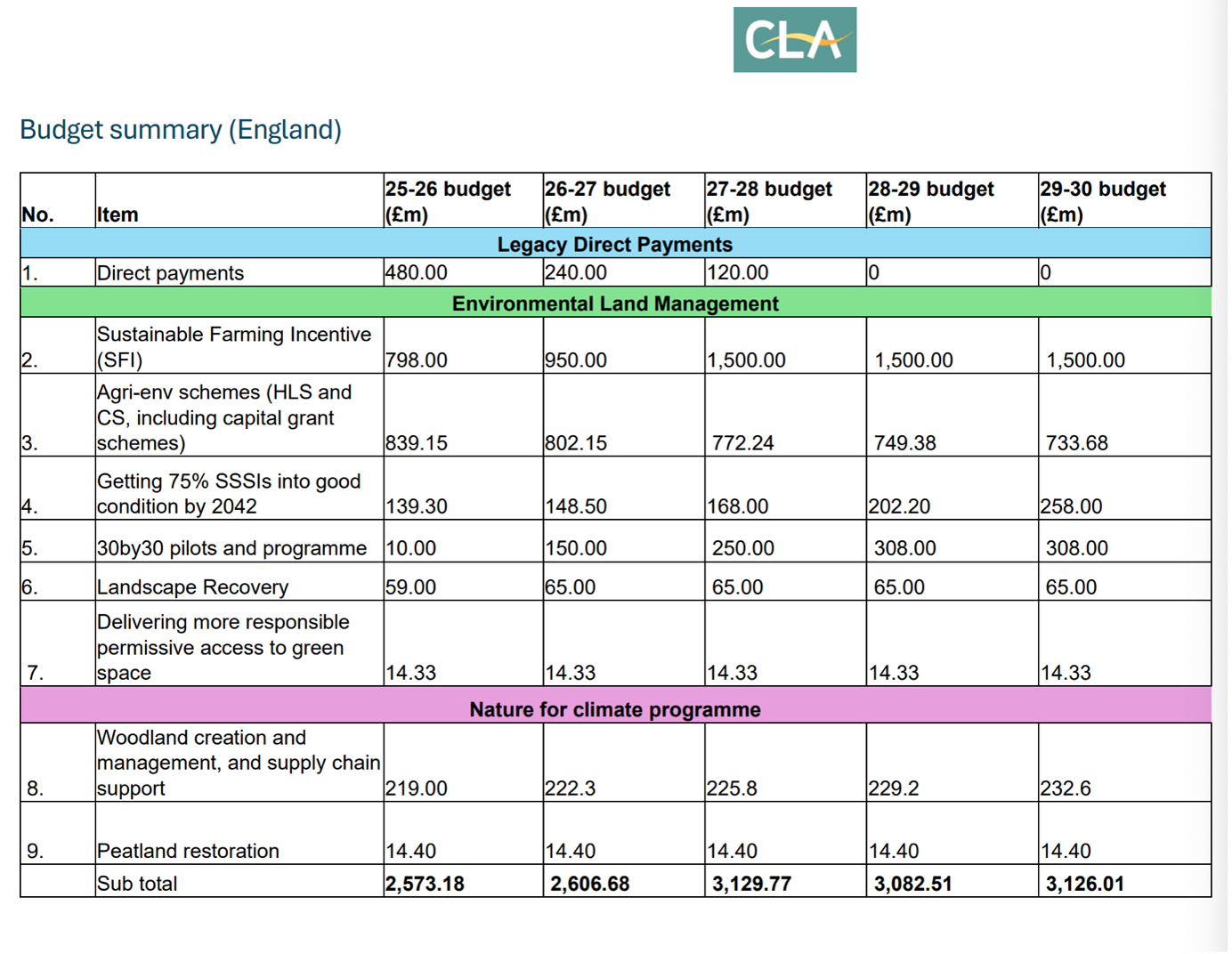
We can therefore include lines 4, 5, 6, 8, and 9, adding £3.4619bn, making the UK’s total estimated spend on nature in 2025-30 £5.1479bn.
This budget also indicates spending on sustainable agriculture to be £6.2bn.
6. Energy efficiency and heat pumps: £10.7bn
Residential decarbonisation is supported by multiple overlapping initiatives:
Warm Homes Plan: The Autumn 2024 Budget committed £3.4bn for the Warm Homes Plan from 2025/26 to 2027/28
Social Housing Decarbonisation Fund: An additional £1.25bn of funding from 2025 will be available through this fund
The government is also investing over £6bn on decarbonising the nation’s homes and building.
This brings the identified committed capital spending to at least £10.65bn.