Who bought the Danish green bonds?
Last week, Denmark made history by becoming the first sovereign issuer of green bonds under the new European Green Bond (EuGB) Standard. But who ended up buying the debt?
In September, Denmark raised DKK 7bn (£800m) on global capital markets through its inaugural EuGB issuance. It was the first time a sovereign issuer had tapped international markets under the new label, which requires proceeds to be fully aligned with the EU taxonomy. While several European corporates have already issued bonds under the framework, sovereigns have been slower to embrace it.
According to the European Environment Agency, governments accounted for just 4.2% of all EU green bond issuance in 2024, up from 3.3% in 2020. By contrast, corporates made up 58.8% of the market last year, raising €33.55bn.
Denmark’s twin issuance
The Danish government said proceeds will refinance spending on sustainable land use, renewable energy and clean transportation. BNP Paribas, Danske Bank, Nordea and SEB acted as joint bookrunners.
The deal was structured as a twin bond, a format first introduced by German authorities, in which a conventional and a green bond are issued simultaneously. The two bonds share identical terms — coupons, payment schedules and maturities — but the green tranche is smaller.
Investor demand was strong, with order books exceeding DKK 12bn. The structure allows investors to track the “greenium” — the spread between yields on conventional and green bonds. Denmark’s green bonds have typically enjoyed a greenium of 2–3 basis points, according to the Anthropocene Fixed Income Institute. This latest deal offered 1.5 basis points, reflecting a broader trend of tightening spreads.
To further support liquidity in the young market, the bond included an unusual feature: investors have the option to convert green bonds into their conventional counterparts.
Investor profiles
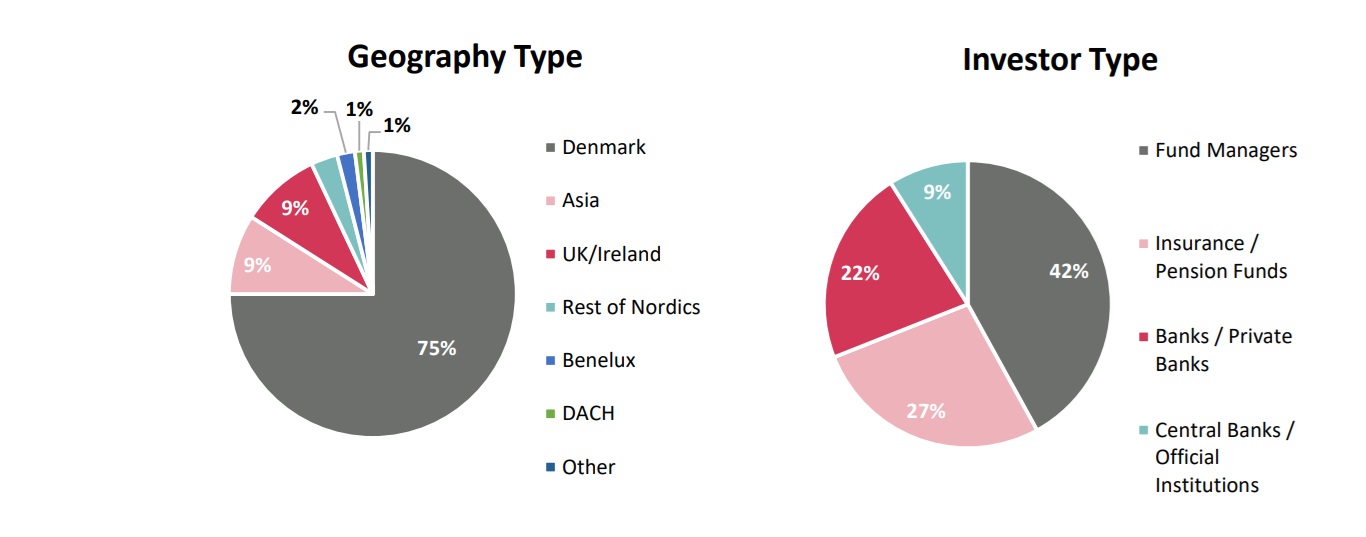
As with many sovereign issues, domestic investors dominated, accounting for around 75% of allocations. Overseas appetite was led by Asia (9%) and the UK (9%), with the remainder placed with buyers in the Benelux, other Nordic countries and the German-speaking region.
By investor type, asset managers bought the largest share (42%), followed by pension funds and other institutions (27%) and banks (22%).
Among the buyers was Danish pension fund P+, which invested DKK 400m (£46m). “First and foremost, we see the green government bond as a good and safe investment in a broad portfolio. At the same time, it makes a lot of sense for P+ to invest in bonds that are in line with the EU taxonomy for sustainable activities and that are earmarked for green expenses in the Danish state budget,” said Jasper Riis, CIO at P+.
A signal to others
Denmark’s successful issuance sends a strong signal to other European sovereigns. In recent years, green bond issuance has slowed amid uncertainty over regulation, political pushback against ESG, and higher borrowing costs. This debut under the EuGB Standard could help shift momentum back in favour of sovereign green debt.