Is the UK government’s net zero strategy enough to build investor confidence?
With the UK government pressing ahead with its net zero pledges and encouraging pension funds to invest more within the country, are they creating the right policy environment for investors?
The UK government has committed to an ambitious national climate plan, aiming to reduce greenhouse gas emissions by 81% from 1990 levels to achieve a net zero economy by 2035, in contrast to policy approaches in other parts of the world. Just before Christmas, the government launched the Clean Power 2030 (CP30) initiative, pledging to reduce fossil fuel use and fully transition to a renewable energy generation. Is this policy direction cultivating the confidence investors need to commit to UK climate-focused investments, or is the jury still out?
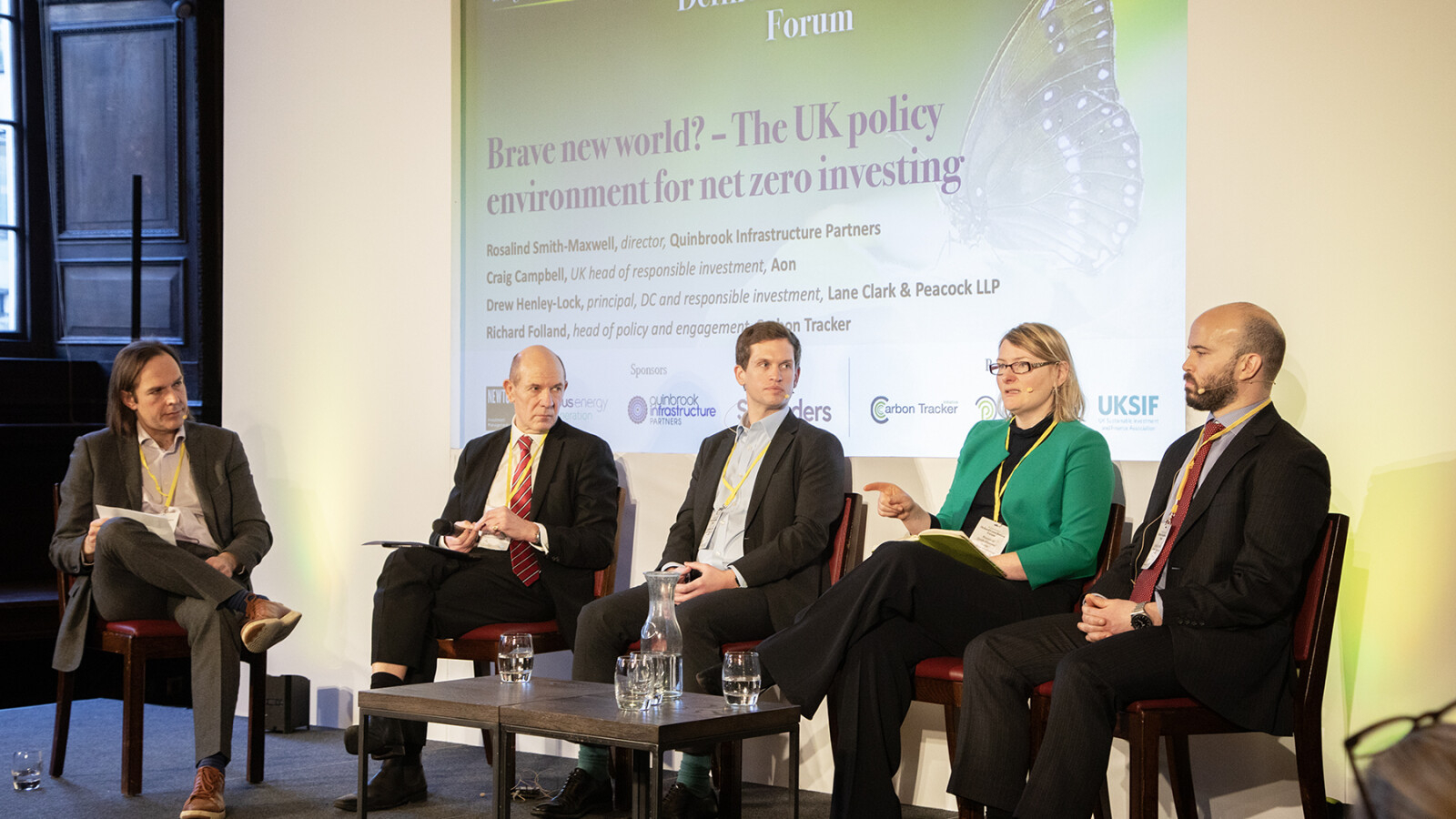
Last week, at the Net Zero Investor’s DC Forum at Stationer’s Hall in London, Rosalind Smith-Maxwell, director at Quinbrook Infrastructure Partners, argued that the government’s CP30 initiative is heading in the right direction. “We now have key stakeholders from government, regulators, and industry all aligned and working together to remove roadblocks. You’ve heard the grid was slow; we now have grid connection reforms…” Smith-Maxwell said.
However, despite the Labour government’s pledges and policy commitments, some asset owners have questioned whether these efforts are enough.
Craig Campbell, UK head of responsible investment at Aon, argued that “policymakers need to create more certainty over long-lasting net zero policies,” adding that the pension industry could then communicate to members that such investments are valuable for their outcomes and, therefore, investable.
He also noted that while UK policy supports net zero, investing in the transition is not without its “challenges,” particularly in energy transition infrastructure, where issues around “fees and liquidity” persist.
Richard Folland, head of policy and engagement at Carbon Tracker, echoed this sentiment, stating that the “jury is still out” on the government’s net zero policy agenda. He emphasised that across government departments, including the Treasury, there needs to be a clearer, more coherent message on decarbonisation, linking it to objectives like lower energy prices and competitiveness.
Mandate fears
At the conference, Campbell also raised the question: “Is it the role of the world’s pension schemes to solve real-world challenges and problems, particularly in regard to the climate transition and its impact?”
This question arose during a discussion about mandating investments into net zero. Drew Henley-Lock, principal at Lane Clark & Peacock LLP, expressed a common fear among the industry that mandating such investments might conflict with fiduciary duty.
“DC structures are generally more concerned about how such mandates will interact with fiduciary duty. Is net zero investing the right path? Or are pension schemes being forced into asset classes that don’t align with their members’ needs?” he questioned.
This fear stems from the UK government's lack of clarity on whether mandating pension fund investments in UK assets is still a possibility. It also comes as the government has been urging UK investors to invest in the country to help meet its "growth" objectives, following chancellor Rachel Reeves' Mansion House speech.
Roger Breeden, professional trustee at BESTrustees, noted that after Reeves’ Mansion House speech, there was “a lot of noise” around the push to invest in the UK, particularly in UK venture capital. “When you read between the lines of what people are signing up to, I haven’t seen any funds significantly linked to the UK [in venture]. Some of our access will be linked to the UK. We’re looking to grow the overall pie in this sector, so the UK will benefit as a consequence. But to say we will be significantly overweight the UK is quite difficult,” he said.
Europe’s Silicon Valley
Adding to this, Reeves recently unveiled plans for “Europe’s Silicon Valley” in the Oxford to Cambridge corridor, aiming to make UK venture capital more attractive for investors. The UK chancellor also confirmed government backing for the expansion of Heathrow Airport, this was alongside announcing other big infrastructure projects.
Addressing the announcement directly, Folland said: “Investors and pension funds need more coherence from the government, you could see some disquiet when Rachel Reeves made the announcement about a third runway for Heathrow, whether that ever comes to pass, I am not convinced at all.”
Paul Lamacraft, head of sustainability and impact at Schroders Capital, pointed out the difference in mindsets between the US and the UK and how that determines its investments.
“We have deep access in the US, there is a mindset in the US of backing innovators right the way through until they have made it. In the UK, we have a slightly more conservative mindset. However, I think these types of initiatives are helping us move forward,” he said.
Echoing Lamacraft’s comments, Zoe Reich, founding partner at OECV, explained that venture capital in the UK is “fundamentally different” to that in the US. “For one, it’s only one-eighth the size,” she said. While the US has a large pool of risk capital, providing substantial opportunities, the UK’s risk capital market is much smaller. That said, Reich highlighted that the UK does have opportunities, particularly in early-stage research.
‘Pigs and shovels’
In a later discussion at the conference, Graham Cook, co-head of investment strategy and sustainability at Phoenix Group, argued that, despite the policy direction, the business case for venture can be quite strong. He stated that, when it comes to investing in the transition, the asset class offers some of the best returns.
He acknowledged the “tension with net zero” and the difficulty of achieving good returns, but suggested that many investors are simply not looking in the right places.
“I’ve been investing for many years, and one thing is clear: the obvious investments, like solar and wind farms, aren’t going to deliver strong returns,” Cook said.
“The ‘nice and fluffy’ investments won’t yield as much as gilts. What we need to focus on are the ‘pigs and shovels’—the less obvious investments that support the transition. You must look across the full spectrum of private markets. But we don’t just think about venture capital or private equity; there’s also infrastructure and private debt.”