“Time to come clean” UN secretary general tells LCAW, pushing for methane cuts and AI transparency
Methane cuts, transparency on the environmental impact of AI and a call to phase out fossil fuels were at the heart of António Guterres speech at the London Climate Action Week
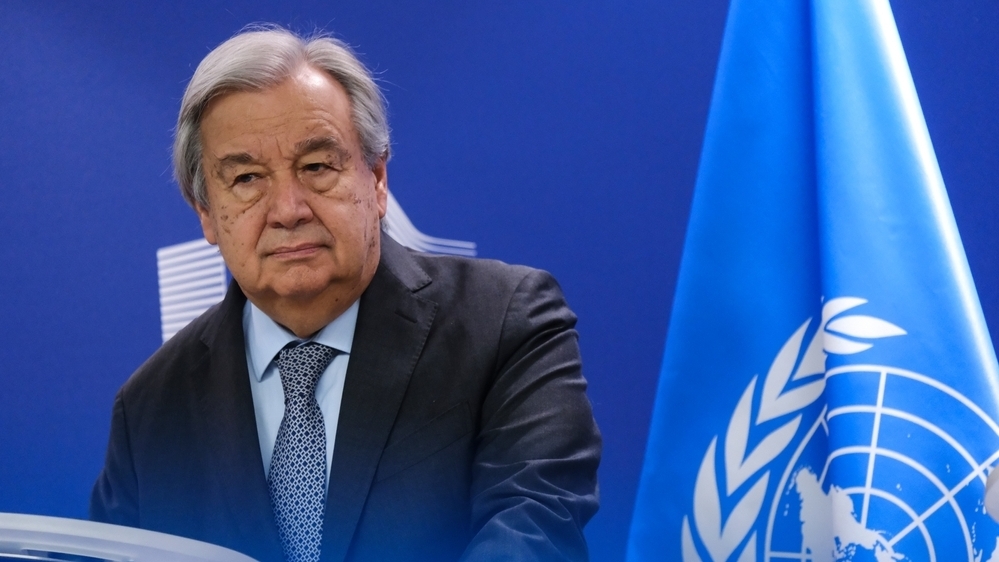
“Crisis brings clarity” UN secretary general António Guterres told an audience of financial industry experts at Bloomberg’s Climate Action Week Philanthropies event, warning that the world now faced a dual crisis of rapidly accelerating global warming and “the mother of all energy shocks.”
Speaking as London faced one of the hottest ever days to be recorded in June, Guterres warned that: “El Niño is not just knocking on the door. It risks blowing the house down.”
NZI Transition and Climate Investment Conference | 22 October | London | Register here
He did not mince his words in his criticism of the fossil fuel industry warning: “We cannot double down on a system based on fossil fuels that is driving both the climate crisis and the energy crisis”. He stressed that renewables are now the cheapest, fastest and most scalable source of electricity.
Call for action on methane
During one of his final speeches in his role at the helm of the UN, Guterres took the opportunity to announce two new initiatives, a call for action to cut methane emissions and the establishment of an Environmental Transparency Initiative on AI.
Highlighting that methane emissions today are responsible for a third of global warming, he emphasised that unlike CO₂, methane breaks down in the atmosphere within a decade or two, predicting that more aggressive cuts could produce visible temperature relief within a generation.
Guterres drew attention to the role of three key sectors adding to methane solutions, the waste, agriculture and fossil fuel industries, warning that voluntary action was no longer enough. Instead, called on governments and the industry for the establishment of a new global standard for the oil and gas sector to achieve near-zero methane emissions across the value chain.
“I am urging the fossil fuel industry to step up and to do what is long overdue” highlighting that the technology for methane emission mitigation was already readily available.
Responding to his call for action the UN Environment Programme (UNEP) and Bloomberg Philanthropies announced efforts to help countries raise their response rate to major methane leaks around the world to 80 percent by 2030. Backed by funding from Bloomberg, UNEP will strengthen and expand the International Methane Emissions Observatory (IMEO) and its flagship Methane Alert and Response System (MARS), allowing countries and companies to accelerate mitigation from the world’s largest methane sources — so-called “super‑emitters.”
Pushing for greater transparency on methane emissions has been a key focus point for institutional investors. Last year, a coalition of 44 major investors representing €4.85trn in assets pushed for the EU to maintain its Methane Emissions Regulation.
‘Hidden costs’ of AI
Another key focus point of his speech was the role of AI in fuelling global energy demand.
Acknowledging that AI can help to accelerate climate solutions, he warned that the data centres driving it already consume more energy than most nations. Much of the environmental damage had so far been a “hidden cost” he warned with greater clarity on the environmental footprint of data centres becoming a priority.
A key aim of the new initiative will be for major AI companies to publicly disclose their environmental footprint, alongside a push for data centres to be entirely fuelled by renewable energy by 2030. “I think it is possible and perfectly reasonable to expect the industry to meet this” he said.
Global electricity generation to supply data centres is projected to grow from 460 TWh in 2024 to over 1 000 TWh in 2030 and 1 300 TWh in 2035, according to the IEA. To date, coal accounts for the largest share of power generated, providing 30% of the electricity, followed by 27% ran by renewables. While natural gas and nuclear account for the remainder of electricity supply to the AI industry, the IEA said.
While tech hyperscalers such as Google and Microsoft have announced voluntary carbon free energy targets, the data centre boom in the US has led to a rush to build gas-fired power plants, with the US now investing more in fossil fuel power than China, the IEA has warned.
Reflecting on his tenure at the helm of the UN, he concluded by stressing the importance of international law. "We see more and more in young people an understanding that the multilateral institutions created at the end of the Second World War need reform, the Security Council needs reform but a world of chaos does not solve any problems, we need multilateral institutions" he concluded.
Longview Networks: Institutional Investment Conferences and Summits